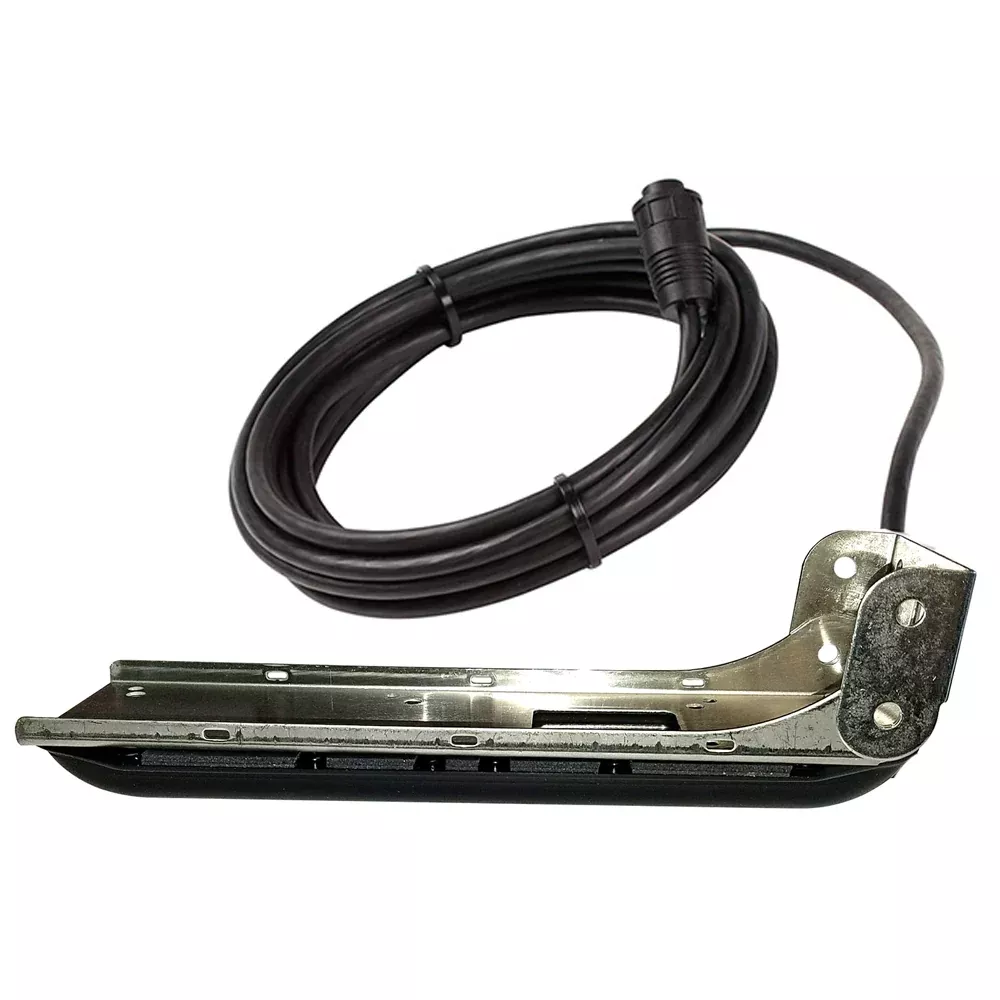
The Lowrance LSS-2 StructureScan HD Transom Mount Transducer (MPN 000-10802-001) is the company’s StructureScan HD imaging transducer in the transom-mount Skimmer configuration – dual-frequency 455 kHz and 800 kHz operation delivering both SideScan Imaging (looks left and right of the boat for structure and fish-holding cover beyond the immediate down view) and DownScan Imaging (high-detail down-imaging directly below the boat) to compatible Lowrance fish finders. Replacement transducer for installations running StructureScan HD-equipped Lowrance HDS Gen2 / Gen3 / Live and other compatible chartplotter / fish finders. Transom mount install with the Lowrance Skimmer pivoting bracket – kicks up if the transducer hits debris or grounding. 13 x 10 x 3 inches, 3 lbs. 1-year limited warranty. Note: this is the older StructureScan HD transducer line, predecessor to the current Active Imaging 3-in-1 transducers – check fish finder compatibility before ordering.
The Lowrance LSS-2 is the company’s StructureScan HD imaging transducer in the transom-mount Skimmer configuration – the previous-generation imaging sonar transducer that paired with Lowrance HDS Gen2 / Gen3 / Live and other StructureScan HD-equipped chartplotter / fish finders. For owners running an older HDS system that needs a replacement StructureScan HD transducer (original transducer damaged, lost, or never included with the chartplotter), the LSS-2 is the right replacement. For new installs on current Lowrance fish finders, the newer Active Imaging 3-in-1 transducer is the right choice – it adds CHIRP traditional sonar to the Side / Down imaging and uses higher imaging frequencies for better resolution. Verify your fish finder compatibility before ordering this LSS-2 vs the newer Active Imaging.
Dual-frequency 455 / 800 kHz operation. The LSS-2 transmits on both 455 kHz and 800 kHz simultaneously, delivering different range / resolution tradeoffs to the chartplotter. 455 kHz is the longer-range frequency – reaches deeper depths (typically 200+ feet of imaging coverage) and wider side-scan range (up to 600 feet per side under good conditions), but with somewhat less detail. 800 kHz is the higher-resolution frequency – shorter range (typically 100 feet of imaging coverage, 200 feet per side scan) but dramatically higher detail (you can see individual rocks, isolated bait, fine bottom structure). The dual-frequency operation lets you choose whichever frequency works for current depth / detail needs.
SideScan Imaging. SideScan looks to the left and right of the boat with two angled transducer beams, painting the bottom contour and any objects on the bottom in a high-detail image that resembles a black-and-white photograph. The killer feature: you can see fish-holding cover (rocks, sunken trees, ledges, reef structure) that’s NOT directly under the boat – it could be 50-300 feet to either side, and the SideScan image shows it clearly. For finding offshore reefs, identifying fish-holding wrecks, mapping ledges along the bottom contour, SideScan is the imaging mode that changed how serious fishermen find structure.
DownScan Imaging. DownScan looks straight down with a high-frequency narrow beam, painting the water column and bottom directly under the boat in extremely high detail. Where traditional fish-finder sonar shows fish as crescents or arches (interpretation required), DownScan shows fish as fish-shaped objects you can identify directly. Bottom structure shows in photographic detail – you can see the difference between hard bottom (rocks, gravel) and soft bottom (mud, sand) by the texture in the DownScan image, and identify individual large objects on the bottom (logs, anchors, dropped gear, structure features).
Skimmer transom-mount design. The transducer mounts on the transom using the Lowrance Skimmer pivoting bracket – a standard transom-mount transducer mount that lets the transducer pivot upward if it hits debris or grounding. The pivoting design protects the transducer from damage when running in shallow water with submerged obstacles. Adjust the mount angle once during install for proper transducer orientation in the water flow, then leave it.
Compatible Lowrance fish finder required. The LSS-2 only works with Lowrance fish finders that include StructureScan HD module support – typically Lowrance HDS Gen2 / Gen3 / Live series chartplotters with the StructureScan HD module either built-in or as a separate plug-in module. Verify your specific fish finder model supports the LSS-2 before ordering. For non-Lowrance fish finders or older Lowrance models without StructureScan HD support, this transducer doesn’t work – it requires the StructureScan HD processing built into the compatible Lowrance fish finder to render the imaging on the display.
Network connection. The LSS-2 connects to the compatible chartplotter via a dedicated transducer cable. Cable length is typical Lowrance transducer cable – sufficient for most boat installations to reach the chartplotter at the helm. For longer runs (very large boats, helms unusually far from the transom), Lowrance offers extension cables.
Older line vs newer Active Imaging – what to know. The LSS-2 StructureScan HD line was Lowrance’s previous imaging transducer technology – it remains in production for replacement purposes on installed HDS systems, but for new installs Lowrance now ships the Active Imaging 3-in-1 transducer line. Active Imaging delivers MEGA-class higher-resolution imaging (1.2 MHz frequency for short-range high-detail imaging) and includes CHIRP traditional sonar in the same transducer (the LSS-2 does only SideScan and DownScan, not traditional CHIRP fish-finding). For owners with current-generation Lowrance fish finders that support both LSS-2 and Active Imaging, Active Imaging is the right call. For owners replacing a transducer on an older HDS system that’s specifically configured for StructureScan HD, the LSS-2 is the compatible replacement.
Imaging coverage and depth performance. The LSS-2 delivers usable SideScan imaging out to typically 300-600 feet per side at 455 kHz under good conditions, dropping to 200 feet per side at 800 kHz. DownScan imaging coverage extends to typically 200-300 feet of water depth at 455 kHz. Coverage varies with water clarity, bottom composition, and boat speed – clear water with hard bottom gives the best coverage, murky water with soft bottom reduces effective range. Ideal trolling speeds for clean imaging are 2-6 mph – faster and the imaging gets blurry. slower and the side-scan strip rate becomes too slow to be useful.
Easy transom install. Mount the Skimmer bracket on the transom using the supplied bolts (drill 4 holes through the transom skin, install bolts with backing plates inside, marine sealant at every penetration). Install the transducer in the bracket and adjust angle for proper water flow alignment. Run the transducer cable forward to the chartplotter, securing along the way to prevent chafe. Connect the cable to the StructureScan HD port on the compatible Lowrance chartplotter. Power up the chartplotter, navigate to the StructureScan setup menu, configure the LSS-2 transducer settings. Total install runs 1-2 hours for someone with reasonable mechanical and marine electrical skills.
1-year limited warranty. Lowrance backs the LSS-2 with a 1-year limited warranty against manufacturing defects under normal recreational use. Service runs through the Lowrance warranty network. Save the receipt and original packaging if practical for warranty service. The transducer’s main wear point is the cable connector – if the cable develops issues over years of flexing, the transducer is typically replaced as a unit rather than serviced.