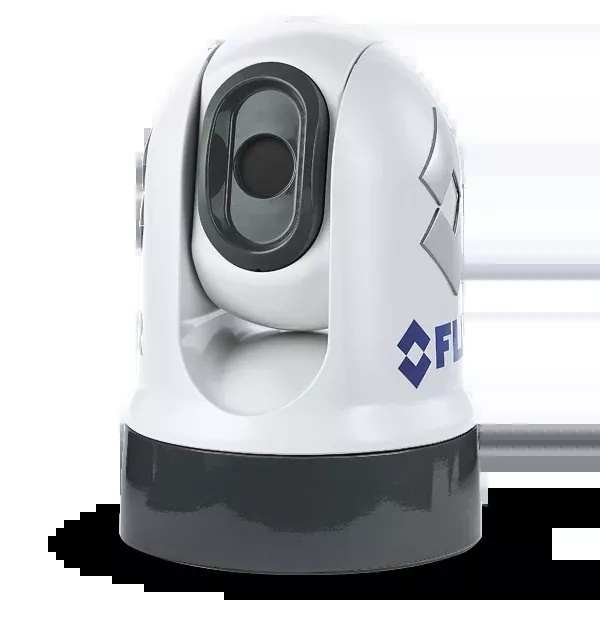
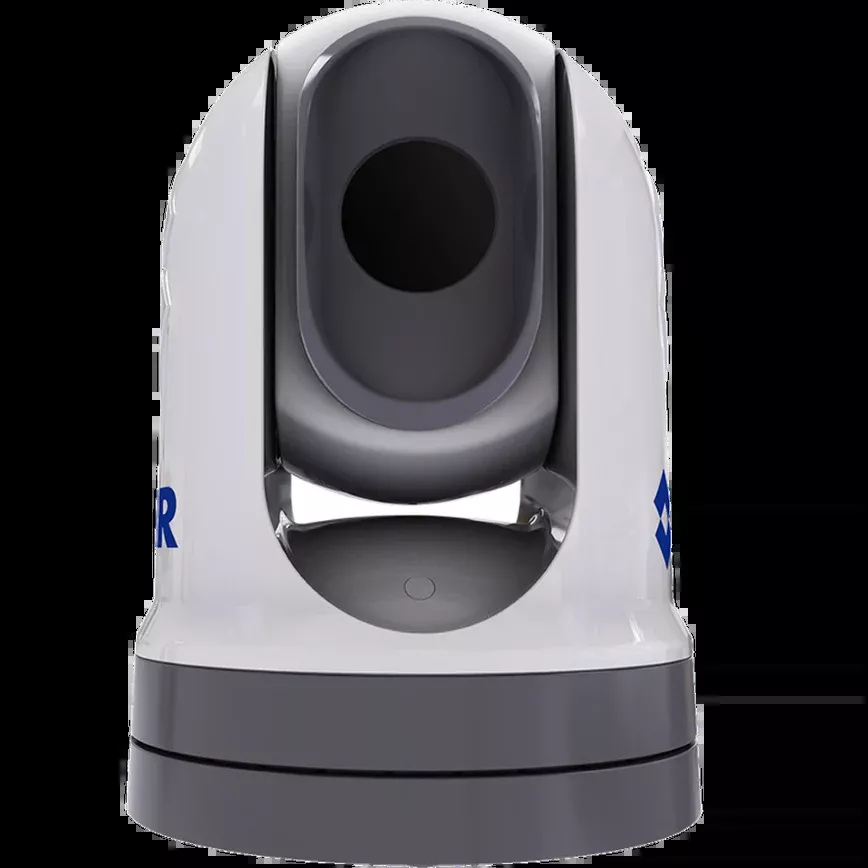
The FLIR M232 is the entry-level FLIR pan / tilt marine thermal imaging camera – the company’s most affordable marine thermal night vision camera with full pan and tilt capability. 320 x 240 thermal resolution from the latest-generation Boson thermal core, 24-degree horizontal x 18-degree vertical field of view, 1,500-foot effective detection range for small vessels and markers, 2x digital zoom, full pan and tilt actuation for active scene scanning. IP video output (or optional analog conversion via Joystick Control Unit kit) for connection to compatible MFD displays. Multiple control options: integrated MFD touchscreen interface on supported chartplotters, the standard FLIR Joystick Control Unit (JCU), or web application control on supported devices. Operating range -13 to 131 degrees F. Weatherproof. White. Two-year limited warranty.
The FLIR M232 is FLIR’s entry-level marine pan / tilt thermal imaging camera – the lowest-cost way to get the powered pan / tilt FLIR thermal capability that has become the standard for serious offshore and overnight cruising boats. Thermal cameras let you see at night, in fog, in glare, and through visual obscuration that defeats traditional optical cameras and even night-vision goggles – and FLIR has been the dominant brand in marine thermal imaging for the past 15 years. The M232 brings that capability into the price range where it makes sense for serious recreational boaters, not just commercial operators.
What thermal imaging actually does. Thermal cameras detect heat emitted by objects in the scene rather than reflected visible light. Anything warmer than its surroundings (or cooler than its surroundings – thermal works in both directions) shows up as a distinct contrast on the thermal image. Real-world: a small boat at night reflects almost no visible light and is essentially invisible to the naked eye or to a flashlight beam, but its hot exhaust, the body heat of the people on board, and the warmth of its hull from the day’s sun exposure all show up on a thermal camera as bright contrasts against the cold dark water. Same principle applies to floating debris, channel markers (cooler than the surrounding water at night), other boats running with no nav lights, swimmers in distress, and the shoreline itself (warmer than the water). Thermal cameras turn a dark night into a usable navigation environment.
320 x 240 Boson thermal core. The thermal sensor is the FLIR Boson – the latest-generation thermal sensor used across FLIR’s marine, automotive, and industrial product lines. 320 x 240 resolution is the entry-level resolution in FLIR’s marine thermal lineup (higher-resolution Boson variants run 640 x 512 in the M364 and M364C class) – meaningfully sharper than older 240-resolution thermals but not as detailed as the higher-end M-Series options. For typical recreational cruising at speeds up to roughly 30 knots and detection ranges within 1,500 feet, the 320 x 240 resolution is sufficient.
Pan / tilt actuation. Unlike the fixed-mount thermal cameras (which point in one direction and require the operator to swing the boat to scan), the M232 has full pan and tilt actuation. Pan rotates the camera 360 degrees horizontally. tilt swings the camera up and down through a useful vertical range. The operator scans the entire scene around the boat from the helm without changing the boat’s heading – meaningful for harbor entries, coastal navigation in heavy traffic, and offshore situational awareness. Pan / tilt also enables auto-tracking modes (the camera locks onto a target and tracks it as the boat moves) and pre-set scan patterns.
24-degree horizontal field of view, 18-degree vertical. The 24-degree horizontal FOV is a moderate-zoom field – wider than a long-zoom thermal (which would have a 12-degree FOV but more reach for distant targets) and narrower than a wide-zoom thermal (45-degree FOV with closer effective range). The 24-degree FOV is the right balance for most recreational marine applications: enough zoom to identify targets at typical detection ranges, wide enough to see the boat’s surroundings without constant panning. The 2x digital zoom extends the effective focal length to roughly 12-degree FOV when needed for target identification.
Detection range up to 1,500 feet. The M232 detects small boats, channel markers, swimmers, and major debris at ranges up to roughly 1,500 feet. Effective detection range varies by target size and thermal contrast – a hot-running outboard motor at night shows up at 2,000+ feet. a cool drifting log shows up at 500-800 feet. a person in the water (warm body, cold water) shows up at 1,000-1,500 feet. The 1,500-foot rating is a typical-conditions number. both better and worse cases happen depending on environmental factors.
IP video output. The M232 outputs digital video over IP (Ethernet) – the modern standard for marine camera integration. Connect via the boat’s existing Ethernet network to a compatible multifunction display (MFD), and the thermal feed appears as a video source on the chartplotter. For boats running an analog video distribution (older video matrix or analog displays), an analog video converter (sold separately as the JCU kit option) provides composite video output. The IP-based architecture is meaningfully more flexible than older proprietary thermal video formats and integrates cleanly with modern marine network infrastructure.
ClearCruise Analytics integration. When the M232 is connected to a compatible Axiom-class MFD, the integrated ClearCruise analytics system processes the thermal feed in real time and highlights non-water objects (boats, markers, debris, swimmers) on the display with color overlay. ClearCruise reduces the operator’s cognitive load – instead of staring at the thermal feed looking for hot spots, the analytics highlight everything that isn’t water and the operator just sees the highlights. Meaningfully better situational awareness, especially in cluttered environments like harbor entries.
Multiple control options. The M232 supports several control schemes. The simplest: integrated touchscreen control via a compatible MFD – swipe and tap to pan / tilt, zoom, and configure the camera. The traditional: the FLIR Joystick Control Unit (JCU), a hardware joystick controller that mounts at the helm for tactile camera control. The flexible: web application control via a phone or tablet on the boat’s WiFi network – useful for boats that don’t have a JCU or compatible MFD installed. The M232 supports all three control modes simultaneously, so different operators on the boat can use whichever interface is convenient.
Weatherproof IP rating. The M232’s housing is rated for marine exposure – withstands wave splash, washdown, rain, and salt-air exposure without water intrusion. The pan / tilt mechanism is sealed against environmental ingress (a cheap pan / tilt mount that lets water into the gimbal eventually fails from corroded gear teeth or seized servos). The M232’s mechanism is engineered for the typical 7-10 year marine service life that boat owners expect from this price-range thermal camera.
Operating temperature -13 to 131 degrees F. The wide operating temperature range covers the full spectrum of typical marine environments – from cold-weather Great Lakes boating (where temperatures can drop below freezing on overnight passages) to hot-weather Gulf coast and tropical fishing (where summer afternoon temperatures hit 100+ degrees in direct sun). The Boson thermal core remains accurate across this temperature range without recalibration.
Install. Mount the camera on a forward-facing location with a clear view of the typical scanning area – the typical install is on the hardtop, on a radar arch, or on the roof of an enclosed flybridge. The included mounting hardware bolts the camera to a flat mounting surface. Run the Ethernet cable from the camera to the boat’s network switch (or directly to the compatible MFD). Run the 12V DC power cable to the camera’s power port. Configure the network settings and pair the camera with the MFD or JCU per the install documentation. Total install time is typically 4-6 hours for a competent boat owner with reasonable mechanical and network skills.
Two-year limited warranty. Standard FLIR warranty terms apply.