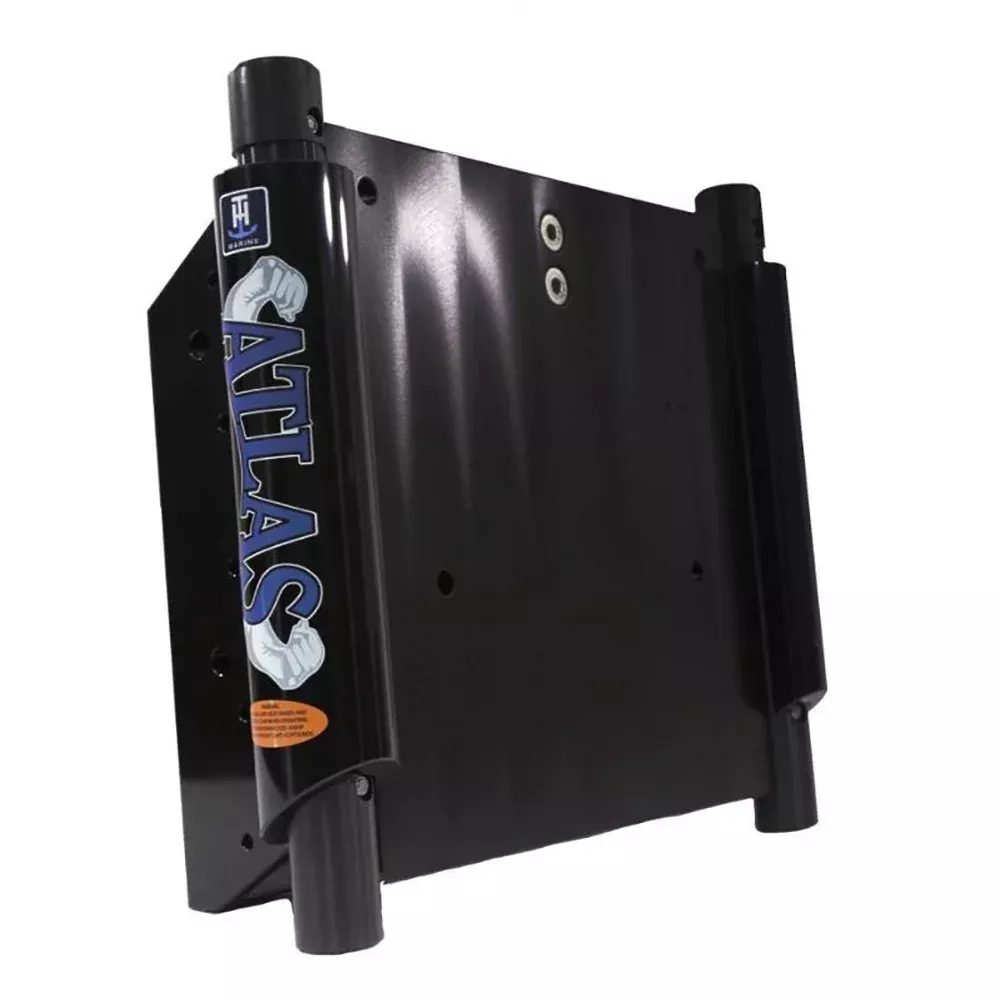
The T-H Marine Atlas 10-inch Hydraulic Jack Plate Standard – Black Anodized (MPN AHJ-10V-B-DP, UPC 733572096002) is a tournament-grade hydraulic jack plate designed for high-performance bass and bay boats running outboards up to 300 horsepower and 625 lb engine weight. The Atlas raises and lowers your outboard motor vertically on demand: trim the motor up for shallow-water running (gets the prop and lower unit higher in the water, reducing the minimum running depth), drop it down for hole-shot acceleration (deeper prop = more bite = better hole shot from rest), and dial in the perfect prop depth for top speed during steady cruising (every inch of prop height affects RPM and top speed – the optimum varies by boat / motor combination and water conditions). The Atlas’s signature feature is the one-piece design with the patented Rod and Slot lifting system – the engine load transfers through a single solid assembly instead of multi-piece bolt-up plates that can develop play over time. This delivers the strength and rigidity required to handle the harshest stresses from heaviest outboards (the 300 HP / 625 lb limits cover essentially everything in current production short of dual-engine offshore setups). 10 inches of setback (the distance the motor sits behind the transom) is the standard bass boat / bay boat setting – the right tradeoff between added top speed (more setback = more speed) and handling (too much setback hurts handling at speed). 5-3/4 inches of hydraulic rise gives plenty of vertical adjustment range during operation – cycle from full-down to full-up in just 8 seconds. Total rise of 8-1/4 to 9-3/4 inches accounts for the setback plus the hydraulic range. All hydraulics built into the jack plate itself – NO separate pumps or reservoirs to mount and route through the transom (a major simplification vs older jack plate designs that required transom-mounted pumps and hose runs – install is hours faster and the system is more reliable with fewer leak points). Includes the dash rocker switch and complete relay harness for direct wiring to your boat’s electrical system. Black anodized aluminum finish for corrosion resistance in saltwater and the typical aesthetic match for modern boats. Limited lifetime warranty backs the assembly. The Atlas is one of the most-installed jack plates in tournament bass fishing – widely considered the standard against which other brands are measured.
The T-H Marine Atlas 10-inch Hydraulic Jack Plate is the workhorse of high-performance bass and bay boat outboard mounting – designed for outboards up to 300 horsepower and 625 lb engine weight, with 10 inches of setback and 5-3/4 inches of hydraulic vertical adjustment. The Atlas is one of the most-installed jack plates in serious bass and tournament fishing – widely considered the standard that other brands are measured against.
What a hydraulic jack plate actually does. The jack plate moves your outboard motor vertically up and down on the transom at the press of a dash button, while the engine is running. Three practical use cases: (1) Shallow water running – trim the motor up to get the prop and lower unit higher in the water, reducing minimum running depth from typical 18-24 inches down to 6-10 inches with the motor fully up. Critical for backwater bass fishing, oyster bar navigation, mud flats. (2) Hole-shot acceleration – drop the motor down for deeper prop bite during acceleration from rest, getting the boat on plane faster. (3) Top-speed tuning – dial in the perfect prop height during steady cruising. Every inch of prop height affects RPM and top speed – the optimum varies by boat / motor combination and water conditions. With a jack plate you’ll find that optimum on every run instead of being stuck at fixed transom height.
The Rod and Slot lifting system. The Atlas’s structural design is built around T-H Marine’s patented Rod and Slot lifting system in a one-piece housing. The engine mounts to a movable slide that rides on a precision-machined slot in the housing, driven up and down by a hydraulic cylinder. The one-piece housing means the load path is a single solid assembly – no bolt-together joints to develop play over time, no flex points to fatigue, no places where high engine loads can work loose. After thousands of hours of high-stress operation (full throttle hole shots, hard turns, rough water pounding), the Rod and Slot system maintains its precision without the drift and play that simpler multi-piece designs develop. Practical impact: the engine doesn’t drift – it stays exactly where you set it, hour after hour, season after season.
Built-in hydraulics – no separate pump or reservoir. Older jack plate designs (and some current competitors) require a separate hydraulic pump and reservoir mounted inside the transom or in a nearby compartment, with hydraulic hose runs to the jack plate. Multiple potential leak points, more install time, more parts to fail, more weight on the boat. The Atlas integrates the hydraulic pump and reservoir directly into the jack plate housing – a single assembly with no external hydraulic plumbing. Install impact: hours faster than competing designs, one wiring connection instead of pump-and-cylinder routing. Reliability impact: dramatically fewer leak points, no hose chafing issues, less to go wrong over years of service.
Speed of operation. The hydraulic unit cycles from full-down to full-up in 8 seconds – fast enough that you’ll adjust motor height in real-time as conditions change. Drop the motor for hole shot, raise it as you accelerate onto plane, fine-tune for top speed on the run – all within seconds of pressing the dash switch. The speed difference vs slower jack plate hydraulics is meaningful in fishing situations where you need to clear the prop quickly when you’ve spotted bottom structure ahead.
10 inch setback and what it means. Setback is the distance the motor sits behind the original transom. 10 inches is the standard bass boat / bay boat setting – it moves the motor away from the transom enough to get the prop into cleaner, less-disturbed water (which adds top speed) without moving so far back that handling suffers. More setback (12-14 inches) is available in larger Atlas models for boats specifically optimized for top speed where some handling compromise is acceptable. Less setback (4-6 inches) is appropriate for smaller boats where added handling beyond what 10 inches provides isn’t beneficial. For typical 18-22 ft bass and bay boats running outboards in the 175-300 HP range, 10 inches is the right balance. Hydraulic rise of 5-3/4 inches gives plenty of adjustment range during operation. Total rise of 8-1/4 to 9-3/4 inches includes the offset from the original transom mounting position – the lower end of that range (8-1/4) is when the motor is in its lowest position. the upper end (9-3/4) is the fully-raised position.
HP and weight limits. Rated for outboards up to 300 horsepower OR 625 pounds (whichever you hit first). Essentially all single outboards currently in production fit within these limits – typical 200 HP outboards weigh 460-500 lb, typical 250 HP outboards weigh 500-540 lb, typical 300 HP outboards weigh 540-625 lb. The 625 lb limit is the binding constraint for most modern 300 HP outboards. NOT rated for twin engine installations or for the 400+ HP racing outboards (those need the heavier-duty Atlas Pro models with higher weight limits).
Dash switch and complete wiring harness included. The Atlas ships with the dash rocker switch (the up / down toggle that goes on your dash within easy reach), the relay harness (the heavy-duty switching that handles the hydraulic pump current), and all the connections needed to wire the system to your boat’s 12V electrical. Run the appropriate gauge marine-tinned cable (typically 10 AWG) from the battery to the relay harness through a 30-40A fuse, route the harness output to the jack plate, mount the dash switch within reach of the helm position, and the install’s complete from a wiring perspective. No specialized hydraulic tools required – the system arrives pre-filled with hydraulic fluid.
Black anodized aluminum finish. The Atlas housing and slide are precision-machined from heavy-duty marine aluminum and finished with hard black anodizing. The anodized finish provides corrosion resistance appropriate for both saltwater and freshwater service (the bare aluminum underneath wouldn’t last in saltwater), plus the standard black aesthetic that matches modern boat trim. Other color variants (silver anodized, custom colors) are available – this is the standard black option.
Install. Plan for 3-6 hours for an experienced installer. Tasks: dismount the existing outboard motor from the transom (typical task – support the motor on a hoist or stand, disconnect fuel, electric, control cables, remove the four transom mounting bolts), mount the Atlas housing to the transom in the original motor mounting holes (the Atlas mounting pattern matches the standard outboard 5-stud pattern), remount the motor onto the Atlas slide using the original outboard mounting bolts, reconnect fuel / electric / control cables (extend cables as needed to accommodate the 10 inch setback), wire 12V power through the supplied relay harness with appropriate fuse protection, mount the dash switch, test full hydraulic range with the engine off before launching, then verify operation on the water. Most installers handle this in a long afternoon – it’s a straightforward bolt-on once you’ve prepped the transom. The Atlas hardware kit includes the proper transom mounting bolts and the through-transom backing plate for solid load distribution.
Warranty. T-H Marine’s limited lifetime warranty backs the Atlas – one of the strongest warranties in the jack plate market. The lifetime warranty is on the mechanical structure (housing, slide, Rod and Slot system). the hydraulic components carry shorter warranty periods that vary by component. Save the receipt and the original packaging. Warranty service runs through T-H Marine’s authorized service network in the U.S. Most field failures T-H Marine sees in the Atlas line are install-related (insufficient transom reinforcement on older boats, undersized power wiring) rather than product defects – careful install delivers many seasons of trouble-free service.