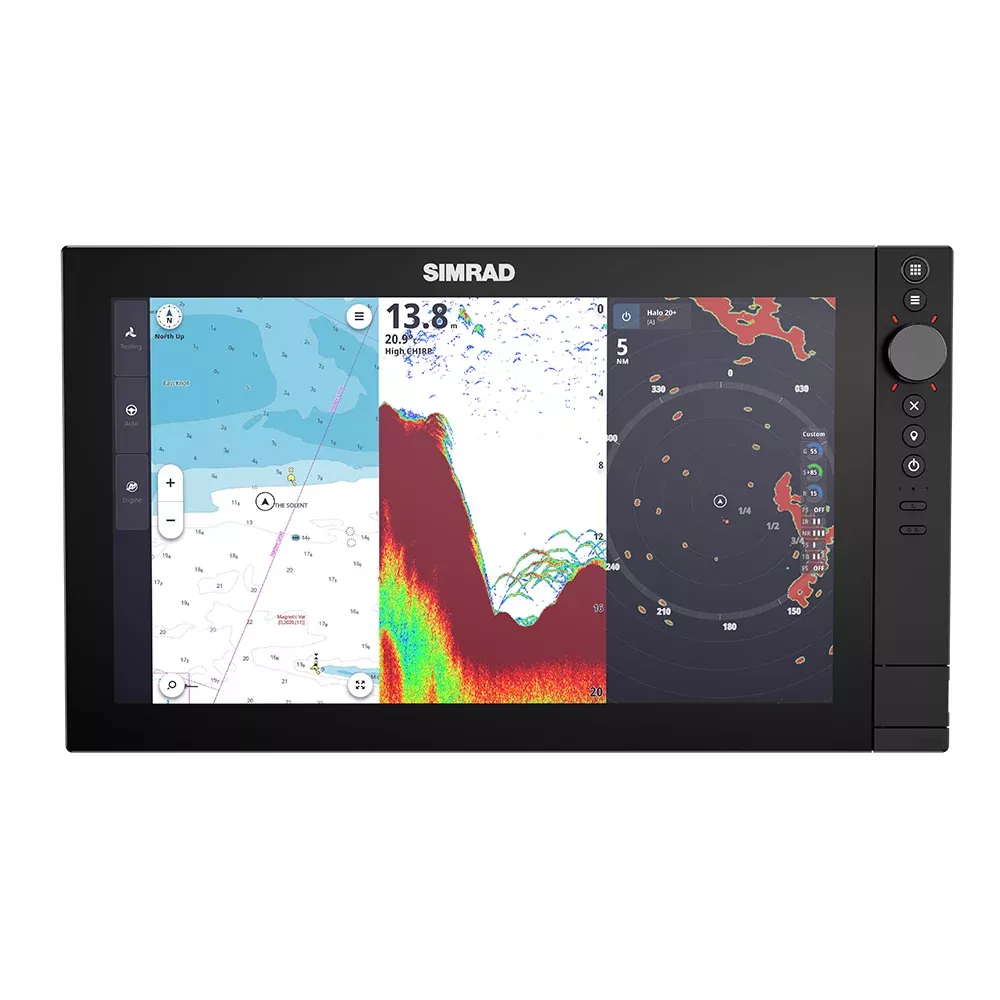
Simrad’s NSS 4-16 16-inch chartplotter MFD in the display-only configuration (no sonar, no chart card included). Same Qualcomm 8-core processor and hybrid touch+rotary+keypad interface as the standard NSS 4-16, configured for installations that drive sonar over the network rather than through built-in transducer ports or already have a chart card in hand.
The NSS 4-16 is the new generation of Simrad’s NSS combo chartplotter line, redesigned inside and out to replace the long-running NSS evo3S. The big architectural change is a Qualcomm 8-core processor that drives a redesigned operating system, paired with hybrid hardware that lets you control the display three ways: multi-touch on the screen, a rotary dial for fast menu scrolling, and a dedicated keypad for one-tap access to common functions. For owners of mid-to-large sportfishers and cruisers who’ve been running an evo3S and want the upgrade, this is the natural next step.
The display itself is a 16-inch SolarMAX IPS panel at 1920 by 1080 pixels with greater than 1200 nits of brightness and 80-degree viewing angles in every direction. Polarized-sunglasses behavior is built in (the IPS film is rotated so the screen doesn’t go dark when you look at it through polarized lenses), and the glass-to-edge bezel design takes up less helm real estate than the older NSS evo3S 16 for the same active screen area. Optical bonding prevents internal fogging in the heat, and the IPX6 / IPX7 rating handles spray, washdown, and short-duration immersion.
The three-control system is the headline ergonomic change. The touchscreen is the primary interface for chart pan, pinch-zoom, and tap-to-select operations, and it’s noticeably smoother on this generation thanks to the new processor. The rotary dial sits beside the screen and scrolls through menus, list views, range adjustments, and instrument-bar values without you having to hunt for an on-screen slider. The keypad provides dedicated keys for the functions you use most: pages, menus, waypoints, escape. For installations where the helmsman wears gloves, or for rough-water situations where a finger on glass is hard to land accurately, the rotary and keypad are real ergonomic wins.
The processor is genuinely faster. Simrad rates the NSS 4 generation at substantially quicker page loads versus the iMX 8 in the evo3S, smoother chart panning, and faster auto-routing. In practical helm use, this shows up as zero-lag app switching when you jump from chart to sonar to radar, and as instant rendering when you scroll a long chart at high zoom levels. The 8-core architecture also handles split-screen layouts more gracefully, you can run a quad-split with chart, radar, sonar, and instruments all live without the lag the older processor had under that load.
There’s no built-in sonar on this variant. The display ships without transducer ports and without a chart card preloaded, which is the right configuration for installations that drive sonar over the network (S3100 or S5100 modules connect via Ethernet and feed sonar data to the chartplotter) and that already have chart cards in hand. The two microSD slots accept C-MAP Discover X and Reveal X, Navionics, CMOR, or StrikeLines cards.
Networking is a generational upgrade. The NSS 4-16 has one X-Coded M12 Gigabit Ethernet port (which is the modern, sealed Ethernet connector replacing the older yellow 5-pin), plus a legacy yellow 5-pin Ethernet port for backwards compatibility with older Simrad accessories. NMEA 2000 carries engine, fuel, instrument, and AIS data. HDMI Video In handles a remote camera feed or an external video source. The display supports IPCAM-1, the FLIR M232/M300 series, and any ONVIF-compliant IP camera for thermal and IP video. Wi-Fi 5 (802.11ax) handles app mirroring and over-the-air software updates.
Charting comes preloaded with the C-MAP Discover X chart card for North America, which is the new C-MAP X-gen format with substantially higher-resolution coastal and inland coverage than the older C-MAP MAX-N+ cards. The display upgrades cleanly to C-MAP Reveal X, which adds high-resolution bathymetric shaded relief, plus third-party charts from CMOR and StrikeLines. Two microSD card slots handle card upgrades and waypoint backup. The NSS 4-16 can store 10,000 waypoints, 75,000 track points, 75 saved tracks, and 125 routes.
Integration is broad. HALO dome and open-array radars all connect over Ethernet. The Simrad RECON trolling motor pairs natively, as do other compatible third-party trolling motors and other compatible third-party trolling motors motors for owners who already run those. NAC-1, NAC-2, NAC-3, and NAC-D autopilot computers are all supported. SiriusXM marine weather works through the WM-4 receiver module. Mercury SmartCraft Connect, CZone digital switching, and the Simrad app on phone or tablet round out the ecosystem.
Power and physicals. The NSS 4-16 runs from 12 or 24V DC nominal, tolerates 10 to 31.2V, draws a maximum of 43.5 W, and uses a 5 A recommended fuse. Operating temperature spans -15 C to +55 C. Display-only dimensions are 423.5 mm wide by 241.6 mm tall by 88.6 mm deep (16.67 by 9.51 by 3.49 in), and weight is 3.8 kg (8.38 lb). The bracket and panel mount kits both ship in the box.