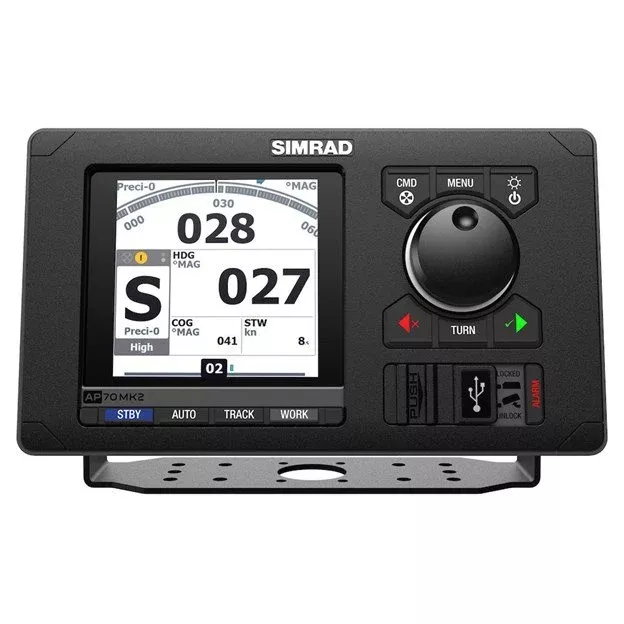
The Simrad AP70 Mk2 is the dedicated commercial-grade autopilot controller engineered for SOLAS-class commercial vessels and serious recreational yachts that need professional autopilot capability. IMO/SOLAS Wheelmarked for SOLAS-class vessels (the regulatory certification required by international maritime law for commercial vessels operating internationally). Single control head replaces both the older AP70 and AP80 controllers, accommodates installations with up to 6 drives or thrusters (previously an AP80-only premium feature, now standard on the Mk2), heavy-duty rudder feedback support, configurable work modes (programmable preset configurations for different operating modes), low / high speed modes (different tuning for harbor maneuvering versus open-water cruising), no-drift steering that holds course against wind and tide, navigation steering with route following, and command transfer support for multiple control stations across larger vessels. Precision rotary control dial plus dedicated buttons for instant access to steering modes. Two-year limited warranty.
The Simrad AP70 Mk2 is the modern professional-grade autopilot controller for SOLAS-class commercial vessels and serious recreational yachts requiring commercial-grade autopilot capability. The Mk2 designation indicates the second-generation refresh of the AP70: same heavy-duty platform reputation, but with a brilliant new display, modernized software interface, and the consolidation of the older AP70 and AP80 control heads into a single Mk2 unit that handles both the recreational-yacht and commercial-vessel use cases. For boats stepping up from recreational autopilot controllers (the NAC-2 / AC-12 class for typical recreational boats) to commercial-class autopilot controllers required for SOLAS compliance, larger commercial vessels, or the most demanding recreational yacht installations, the AP70 Mk2 is the right call.
SOLAS Wheelmark – what it actually means and why it matters. The IMO Marine Equipment Directive (MED) requires equipment installed on commercial vessels operating internationally to be Wheelmarked – certified to specific performance and safety standards by an accredited testing laboratory. The Wheelmark (the mark resembling a ship’s wheel) on equipment indicates the unit has passed the certification process. For commercial vessels (cargo ships, ferries, tugboats, fishing vessels above certain size thresholds), Wheelmarked equipment is legally required – non-Wheelmarked autopilots can’t be installed on these vessels. For recreational yachts, Wheelmarked equipment isn’t legally required but is meaningful evidence of professional-grade quality. The AP70 Mk2 carries the Wheelmark, so it’s both legally compliant for commercial install and quality-assured for any install.
Replaces both AP70 and AP80 control heads. The Mk2 consolidates the previous-generation AP70 (the standard professional autopilot controller) and the AP80 (the premium variant with up to 6-drive support) into one unit. The Mk2 has the up-to-6-drives capability that was the AP80’s main differentiator – so customers who would have specified an AP80 in the past now get the same capability from the standard Mk2. Single SKU, broader use-case coverage, simpler product line. For owners with existing AP70 / AP80 installs that need controller replacement, the AP70 Mk2 is the direct replacement for either older unit.
Up to 6 drives / thrusters integration. The Mk2 supports installations with up to 6 separate drive units – a meaningful capability for large vessels with multiple steering systems or with thruster integration. Typical multi-drive scenarios: large commercial vessels with multiple rudders driven by independent hydraulic systems (twin-rudder ferries, large fishing vessels with multi-rudder configurations), vessels with primary rudder steering plus stern thruster integration (the autopilot can use the thruster for low-speed maneuvering when the rudder isn’t effective), or vessels with primary rudder plus bow thruster plus stern thruster all integrated into the autopilot’s control logic. The 6-drive capability is meaningful for large-vessel applications where the autopilot must coordinate multiple actuator systems for proper steering control.
Heavy-duty rudder feedback support. Commercial-grade rudder feedback units provide more accurate position data, higher mechanical reliability under continuous duty cycling, and longer service life than recreational-grade feedback units. The AP70 Mk2 supports the heavy-duty feedback units required for commercial installs and demanding recreational applications – the wider voltage range, the higher current handling, and the more precise position resolution that commercial-grade installs need.
Configurable work modes. The Mk2 supports user-configurable work modes – preset configurations that the operator can switch between with a single button press. Typical work mode setups: harbor mode (low-speed maneuvering tuning, immediate response to operator inputs, integrated thruster control), open-water cruising mode (smooth course-keeping with minimal yaw, low-rudder-activity tuning that conserves hydraulic actuator service life), heavy-weather mode (more aggressive course corrections to maintain heading in confused seas), and similar custom configurations the operator defines. The work-mode preset switching is meaningfully faster than manually re-configuring the autopilot’s parameters every time conditions change.
Low / high speed modes. Separate from the work modes, the Mk2 has built-in low-speed and high-speed tuning modes. Low-speed mode is optimized for harbor maneuvering where rudder authority is reduced (low water flow over the rudder at low boat speed) and the autopilot needs to use thrusters more aggressively. High-speed mode is optimized for open-water cruising where rudder is the primary actuator and the autopilot can use lighter rudder corrections. The low / high speed modes are meaningful for vessels operating in mixed conditions (harbor approach, channel transit, open-water cruising all in the same trip).
No-drift steering against wind and tide. The autopilot’s no-drift steering algorithm holds the boat on a true course rather than just a heading – meaning if wind / tide is pushing the boat sideways, the autopilot adjusts the heading to compensate so the boat actually tracks the desired course over ground. Older autopilots without no-drift would hold a heading and let the boat drift downwind / down-current, which means significant deviation from the intended track over a long passage. The no-drift algorithm is meaningful for accurate passage-making, especially in heavy current or strong cross-wind conditions.
Navigation steering with route following. The Mk2 connects to a chartplotter via NMEA 2000 and follows routes set on the chartplotter. The chartplotter sends waypoint data. the autopilot steers the boat along the route from one waypoint to the next, with appropriate turn-anticipation as each waypoint is approached. For large vessels and serious recreational yachts that run pre-planned routes for offshore passages, the route-following capability eliminates the need for the operator to manually steer to each waypoint – the autopilot handles the entire route automatically.
Command transfer for multiple control stations. The Mk2 supports command transfer between multiple control stations – useful for vessels with multiple helms (typical of larger yachts with both an inside helm and a flybridge helm, or commercial vessels with bridge plus aft control stations). Each control station has its own control head, and command can transfer between stations with explicit user action – one station has active control at a time, with handoff procedures that require positive acknowledgment to prevent accidental control conflicts.
Precision rotary dial plus dedicated buttons. The user interface combines a precision rotary dial (for fine course adjustment – turn the dial 1 click for 1-degree heading change) with dedicated hardware buttons for steering modes (auto, standby, no-drift, navigation), work modes, and emergency override. The combination is meaningful for high-stress situations – the rotary dial gives fine control without menu navigation, and the dedicated buttons provide instant access to mode changes without scrolling through screens.
Brilliant display with modernized software interface. The Mk2 features the brilliant new color display – higher resolution, better sunlight readability, better viewing angles than the older AP70 / AP80 monochrome displays. The modernized software interface is more intuitive (closer to modern smartphone / tablet UIs) and has better diagnostic / configuration tools for installers. For operators familiar with older Simrad commercial autopilots, the Mk2’s interface is meaningfully easier to use while maintaining the operational feel of the platform.
Control Head Only – what’s NOT included. This SKU is the control head only – not a complete autopilot system. A complete commercial autopilot install requires additional components: the autopilot computer (the brain that interfaces between the control head and the drive units), the drive units (the hydraulic pumps or electric drives that physically move the rudder), the rudder feedback unit (reports rudder position to the autopilot computer), the heading sensor (provides true heading – typically a fluxgate compass or GPS-aided compass), and the appropriate power supply and wiring. For complete autopilot installations, the AP70 Mk2 control head is one of multiple components that must be specified together.
Two-year limited warranty. Standard Simrad professional warranty terms apply. Service runs through the Simrad Professional service network – separate from the recreational Simrad service network that handles consumer-grade products.