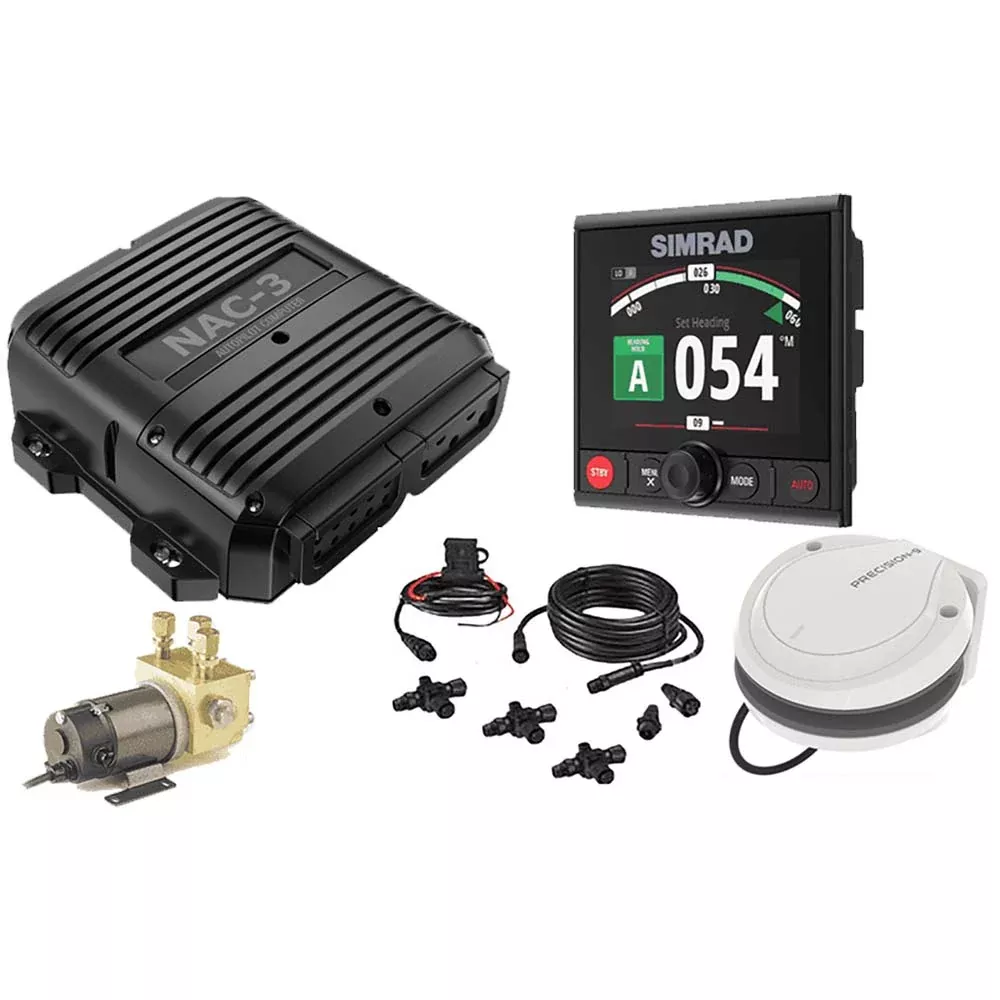
The Simrad AP44 VRF High Capacity Autopilot Pack (MPN 000-13562-002, UPC 9420064128228) bundles the complete autopilot system for hydraulically-steered boats 33 feet and larger: AP44 dedicated autopilot controller, NAC-3 autopilot computer, Precision-9 solid-state compass, PUMP-3 MK2 12V 1.6L high-capacity hydraulic pump, plus the NMEA 2000 power cable and terminator kit. VRF stands for Virtual Rudder Feedback – the system derives rudder position from pump output and compass data, eliminating the need to install a physical rudder feedback sensor on the rudder post. Major install simplification for boats where mounting a physical rudder sensor is difficult (sail drives, outboards with complex steering linkages, twin-hydraulic helms). The AP44 controller features a 4.1-inch optically bonded color display readable in direct sunlight, intuitive rotary dial for course adjustment, and four-button interface for primary autopilot functions. NAC-3 autopilot computer drives hydraulic pumps and mechanical steering up to 30 amps continuous (50 amps peak) – the high-current rating for boats 33 ft and larger with serious steering loads. PUMP-3 MK2 is the 1.6 liter high-capacity hydraulic pump matched to mid-size yachts and sportfishers with the corresponding steering ram size. Precision-9 solid-state compass provides heading and rate-of-turn data with marine-grade reliability. Simrad Continuum steering technology with built-in algorithms for automated turn patterns (U-turn, square turn, circle, spiral, search patterns for fishing / diving), No Drift steering (compensates for wind and current to track a true straight-line course), and Depth Contour Tracking (follow an underwater contour line automatically). Full NMEA 2000 integration with Simrad NSS evo3 / NSO / GO chartplotters, sister-brand H5000 systems, sister-brand HDS displays, and other NMEA 2000 helm electronics. 60+ years of Simrad autopilot R&D from the autopilot research hub in Norway. Complete pack – everything needed for a clean install except the hydraulic plumbing tee fittings and bleed hardware specific to your boat’s steering system.
The Simrad AP44 VRF High Capacity Autopilot Pack is the complete autopilot bundle for hydraulically-steered boats 33 feet and larger – everything from the helm controller to the hydraulic pump in one box. For owners of mid-size sportfishers, cruising yachts, and powerboats who want a serious autopilot with proper engineering depth (not a budget pilot from a smaller-yacht manufacturer), the AP44 pack is Simrad’s mid-tier offering between the smaller AP24 and the larger commercial-grade pilots.
What VRF means – and why it matters. VRF stands for Virtual Rudder Feedback. Traditional autopilots require a physical rudder feedback sensor mounted on the rudder post that reports the rudder’s actual angle to the autopilot computer in real time. The autopilot uses this rudder angle data to know how much steering input it has applied. The problem: installing a physical rudder feedback sensor is the hardest part of an autopilot install on many boats – sail drives don’t have an accessible rudder post, outboards have complex steering linkages, twin-engine boats have two rudders (or steering systems) to track. VRF eliminates the physical rudder feedback sensor entirely – the system derives rudder position from the pump output (how much hydraulic fluid has been pumped and in what direction) combined with the compass heading change response. The trade-off: VRF requires precise compass calibration during setup, and heading can wander slightly in heavy chop where the compass response lags. For most installations, VRF is a major install simplification with negligible operational compromise.
What’s in the pack. Five components: (1) AP44 autopilot controller – the helm-mount display and control unit, (2) NAC-3 autopilot computer – the processor that runs the steering algorithms and drives the pump, (3) Precision-9 solid-state compass – the heading and rate-of-turn sensor, (4) PUMP-3 MK2 – the 12V 1.6L high-capacity hydraulic pump that actually moves the steering ram, and (5) NMEA 2000 power cable kit and terminator kit for the network bus. Everything you need for an autopilot install except the hydraulic tee fittings and bleed hardware specific to your boat’s steering system (sourced separately based on your steering ram size and hydraulic line sizing).
AP44 controller – the helm interface. 4.1-inch optically bonded color display – the optical bonding eliminates the air gap between the LCD and the cover glass, improving sunlight readability and reducing internal condensation. Mounts in standard 4-1/8 inch panel cutouts. Four buttons handle the primary functions: Auto / Standby toggle (engage / disengage), MODE selection (heading hold, no drift, route follow, etc.), MENU for advanced settings, and PWR for power on/off and night mode. Rotary dial with push-to-enter handles course adjustment – twist to change course in 1-degree or 10-degree increments, push to engage the new course. The dedicated controller design is a meaningful upgrade over autopilot integration through a multifunction display – faster access to autopilot functions when you need them quickly, and the controls are physical (not touchscreen) so they work reliably with wet hands, in rough water, and in heavy gloves.
NAC-3 autopilot computer – the brain. The NAC-3 runs Simrad’s Continuum steering algorithms – the same control software developed at Simrad’s autopilot research hub in Norway with over 60 years of marine autopilot development behind it. Sized for boats 33 feet (10 meters) and larger, the NAC-3 is rated for 30 amps continuous and 50 amps peak – enough current capacity to drive serious hydraulic pumps and mechanical steering systems found on mid-size yachts and sportfishers. The NAC-3 interfaces with the helm controller via NMEA 2000 (so you can locate the computer wherever makes physical sense for the install – typically in a dry area near the steering equipment) and connects directly to the pump and rudder feedback sensor (or in VRF mode, just the pump and compass).
PUMP-3 MK2 – the hydraulic muscle. 12V hydraulic pump with 1.6 liter displacement per minute – the high-capacity variant for steering systems with corresponding ram size and hydraulic line diameter. Matches mid-size yachts and sportfishers (typically 33-45 ft hydraulic steering installations). For smaller boats (under 33 ft with smaller steering rams), the medium-capacity variant (different pack) is the appropriate sizing. For larger boats (50+ ft with large steering rams), step up to the Pump-5 or external power steering integration. Sizing the pump correctly matters – undersized pump can’t move the steering fast enough, oversized pump wastes power and can over-correct.
Precision-9 solid-state compass. The Precision-9 provides heading and rate-of-turn data using solid-state sensor technology (no moving parts, no gimbal, no fluid). Compact installation – mount anywhere on the boat that’s away from magnetic interference (engines, speakers, large iron objects, large wiring runs). The Precision-9 also powers Simrad and sister-brand autopilot, radar overlay, and navigation systems – one compass, multiple downstream systems. For boats with existing Simrad and sister-brand electronics, the Precision-9 integrates cleanly with the existing ecosystem.
Simrad Continuum steering. The steering algorithms in the NAC-3 are Simrad’s Continuum technology – over six decades of autopilot development distilled into the control logic. The practical benefits: tighter heading hold (less wander in moderate seas), smoother course corrections (no aggressive steering corrections that cause passenger discomfort), better wind / current compensation (the algorithms recognize and adapt to environmental forces), and lower power consumption (the algorithms make fewer unnecessary steering corrections, reducing pump cycling).
Built-in automated turn patterns. The AP44 controller includes a library of built-in turn patterns – press the pattern button, select the pattern, and the autopilot executes it: U-turn (180-degree turn at your specified turn rate, useful for quick course reversal), Square Turn (90-degree turns at corners of a specified-size square, useful for canyon trolling), Circle (constant-radius circle around a point, useful for circling a productive fishing spot or a dive site), Spiral (expanding or contracting spiral, useful for search patterns), and various search patterns (sector search, expanding square, etc., useful for SAR or finding a lost gear point). The patterns work in standalone mode without a chartplotter – critical for situations where the chartplotter is unavailable but you need autopilot pattern steering.
No Drift steering. Standard heading hold maintains a constant compass heading – but wind and current push the boat sideways off the heading line, so the actual track over ground curves away from the intended course. No Drift steering compensates – the autopilot constantly adjusts heading to maintain a true straight-line course over ground regardless of wind and current. Useful for crab-angle compensation when crossing strong currents or running across heavy crosswind.
Depth Contour Tracking. With a compatible depth sensor / sonar transducer on the NMEA 2000 network, the autopilot can follow a specified depth contour automatically – useful for trolling along a productive depth line (e.g., the 100-foot contour for offshore tuna trolling, the 50-foot contour for walleye trolling, the 30-foot drop-off for striped bass fishing). The autopilot adjusts heading to keep the boat on the specified depth, executing the same path the contour line follows.
NMEA 2000 integration. The entire AP44 system runs on NMEA 2000 – the standard marine network protocol. Pairs cleanly with Simrad NSS evo3 / NSO / GO chartplotters (full autopilot control from the chartplotter touchscreen, route following with automatic waypoint-to-waypoint steering), sister-brand H5000 systems on sailboats, sister-brand HDS displays, and any other NMEA 2000 helm electronics. The NMEA 2000 power cable kit and terminator kit included in the pack handle the network installation requirements.
Installation overview. Plan for a professional marine install if you don’t have hydraulic and 12V electrical experience – this is not a typical DIY project. Key tasks: install the PUMP-3 MK2 in the hydraulic steering circuit using appropriate tee fittings (parallel-to-helm-pump configuration is standard), wire the pump to the NAC-3 computer with appropriately-sized power cable (4 AWG minimum for the 30A continuous current draw), mount the NAC-3 computer in a dry location with NMEA 2000 network access, mount the Precision-9 compass in a location away from magnetic interference, mount the AP44 controller at the helm, run NMEA 2000 backbone with the included power cable and terminator, bleed the hydraulic steering thoroughly (twice – the first bleed pass typically misses air pockets), and run the auto-tune calibration procedure with the boat in calm water. Total install time for a professional: 8-16 hours depending on boat complexity. DIY install: 16-24 hours if you have the relevant skills.