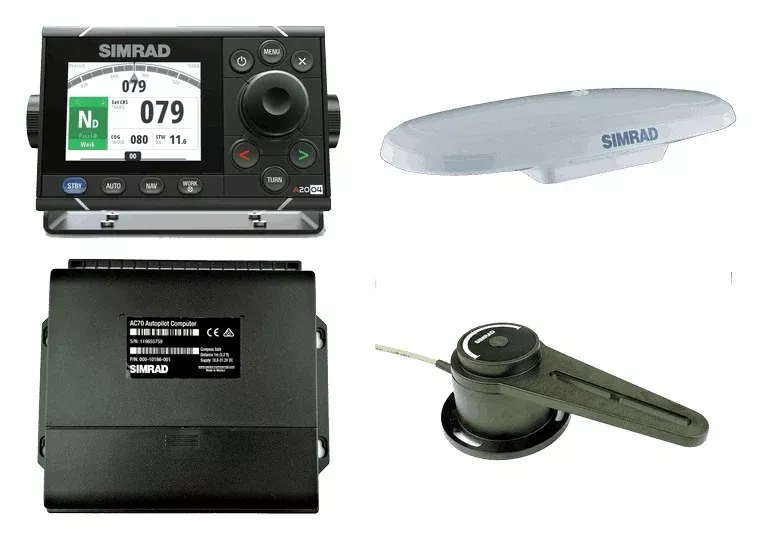
Simrad’s professional A2004 autopilot kit built for non-IMO commercial vessels. The bundle includes the A2004 dedicated controller with rotary dial, the AC70 autopilot computer, the RF300 rudder feedback unit, and the HS75 GPS compass for reversible pumps or non-isolated solenoid valve drives.
The Simrad A2004 System Kit with HS75 (MPN 000-13901-001) is a complete autopilot pack purpose-built for non-IMO professional commercial vessels operating with reversible hydraulic pumps or non-isolated solenoid valve drive systems. The kit bundles four components, the A2004 dedicated autopilot controller, the AC70 autopilot computer (the brain of the system), the RF300 rudder feedback unit, and the HS75 GPS compass for heading reference. For commercial vessels building or refitting a serious autopilot setup, this kit delivers the components needed for the install in one purchase.
What “non-IMO” means. IMO (International Maritime Organization) certification applies to large commercial vessels in international service that must meet specific autopilot regulatory requirements. Non-IMO covers domestic commercial vessels, work boats, charter operations, and other professional vessels that operate below IMO certification thresholds. The A2004 is designed for this non-IMO professional segment, delivering commercial-grade autopilot capability without the regulatory complexity (and cost) of IMO certification. For most domestic commercial operators, non-IMO is the right tier.
What drives this kit supports. The A2004 kit’s configured for reversible hydraulic pumps or non-isolated solenoid valve controls. Reversible pump drives are the typical hydraulic steering autopilot architecture used on smaller commercial vessels. Non-isolated solenoid valve controls work with hydraulic systems where the autopilot manages valve actuation directly. For vessels with different drive architectures (continuous-running pumps, isolated solenoid systems, electric drives), Simrad offers different autopilot computer configurations. Verify your boat’s steering system drive type during install planning.
A2004 dedicated autopilot controller. The A2004 controller delivers the proven Simrad interface in a dedicated autopilot user interface unit, with an optically bonded 4.1-inch color display, 170-degree viewing angle, and zero-fog operation. The interface and keypad layout are inherited from the established Simrad AP70 and AP80 professional autopilot controllers, so operators familiar with those products transfer to the A2004 immediately. The optical bonding keeps the display fog-free in marine temperature swings (critical for open wheelhouse and exposed-bridge installations), and the wide viewing angle keeps the display readable from any position at the helm.
Large rotary control dial. The A2004’s large heavy-duty rotary control dial delivers precision steering input that the operator can manipulate without taking eyes off the navigation picture. For commercial vessel operators who need tactile heading adjustment under operational pressure, the rotary dial is the right input device. Dedicated buttons surround the dial for instant access to steering modes, the custom-configurable Work mode, and the automated turn patterns.
Continuum steering technology. Simrad’s Continuum steering algorithm delivers smooth heading changes and course holding that minimizes overcorrection and oscillation. The autopilot makes small continuous corrections rather than large step inputs, which means tighter course holding, reduced rudder wear, and better fuel economy. For commercial vessels where operating hours are long and every percentage of fuel matters, Continuum is operationally meaningful.
Configurable Work mode. The Work mode is a custom-configurable autopilot mode that lets the operator define specific steering parameters for the boat’s operational use case. For commercial vessels with specific maneuvering requirements (towing, trawling, surveying, escort work), the Work mode delivers a saved configuration that matches the operational task rather than requiring re-tuning each time. The low and high speed modes provide additional configuration for the boat’s speed range.
Automated turn patterns. Pre-programmed turn patterns deliver fuel-efficient hands-free maneuvers, including U-turn, spiral turn, depth contour following, and similar patterns. For commercial vessels that frequently perform standardized maneuvers (search patterns, station-keeping arcs, deployment patterns), the automated patterns eliminate the manual steering work and deliver consistent execution.
No Drift steering mode. No Drift mode holds the boat on the actual course over ground (COG) by automatically compensating for wind and tide set. Where standard heading-hold autopilot just maintains the boat’s bow direction (which means the boat drifts off-track in current and wind), No Drift mode adjusts steering input to keep the boat on the planned course line. For commercial work that requires accurate track-following (channel navigation, transit, point-to-point delivery), No Drift is operationally meaningful.
HS75 GPS compass. The included HS75 GPS compass delivers GNSS-based heading reference to the autopilot, with the accuracy needed for commercial-grade course holding. Unlike magnetic compass or basic GPS course-over-ground (COG) data, the GNSS-based heading from the HS75 is accurate independent of vessel motion, magnetic interference, or speed-over-ground. For autopilot operation that depends on accurate heading reference, the HS75 is the right sensor.
RF300 rudder feedback. The included RF300 rudder feedback unit reports actual rudder position back to the autopilot computer, which closes the steering control loop. Without rudder feedback, the autopilot is open-loop and can’t compensate for steering system slop or hysteresis. With rudder feedback, the autopilot delivers precise rudder positioning that translates operator heading commands into actual rudder angles.
Thruster integration support. The A2004 supports thruster integration when combined with the optional AD80 or SD80 thruster control adapter (sold separately). For commercial vessels with bow thrusters that need autopilot-integrated control during maneuvering, the thruster adapter delivers that integration. For vessels without thrusters, the A2004 functions normally without the adapter.
NMEA 2000 certified connectivity. The A2004 system integrates with the boat’s NMEA 2000 backbone for connection to chartplotters, instruments, and other helm electronics. NMEA 2000 certification ensures interoperability with other certified products from Simrad and other manufacturers in the NMEA 2000 ecosystem.
Install considerations. The A2004 controller mounts at the helm via flush mount or bracket mount. The AC70 autopilot computer mounts below decks in the electronics bay. The RF300 rudder feedback unit mounts at the rudder post with mechanical linkage to the rudder. The HS75 GPS compass mounts on the upper deck with clear sky view. Cable runs include NMEA 2000 backbone, autopilot computer to drive system, rudder feedback to autopilot, and GPS compass to autopilot computer. Total install is a marine electronics installer multi-day job for a clean integration, including sea-trial calibration. Not casual DIY because of the autopilot commissioning complexity, drive-system integration, and sea-trial tuning.
Why pay this much. Three reasons. First, the A2004 is the dedicated autopilot controller built for commercial professional use, with the proven Simrad interface, rotary dial, large display, and operational modes that commercial operators need. Second, the bundled kit includes all four components needed for the install (controller, computer, rudder feedback, GPS compass), so the procurement is one purchase rather than four. Third, the Simrad commercial autopilot service network is established for the AP-line and A2004 product lines, with established dealer support. For commercial vessel operators building a serious autopilot setup on Simrad, the A2004 kit earns its position.