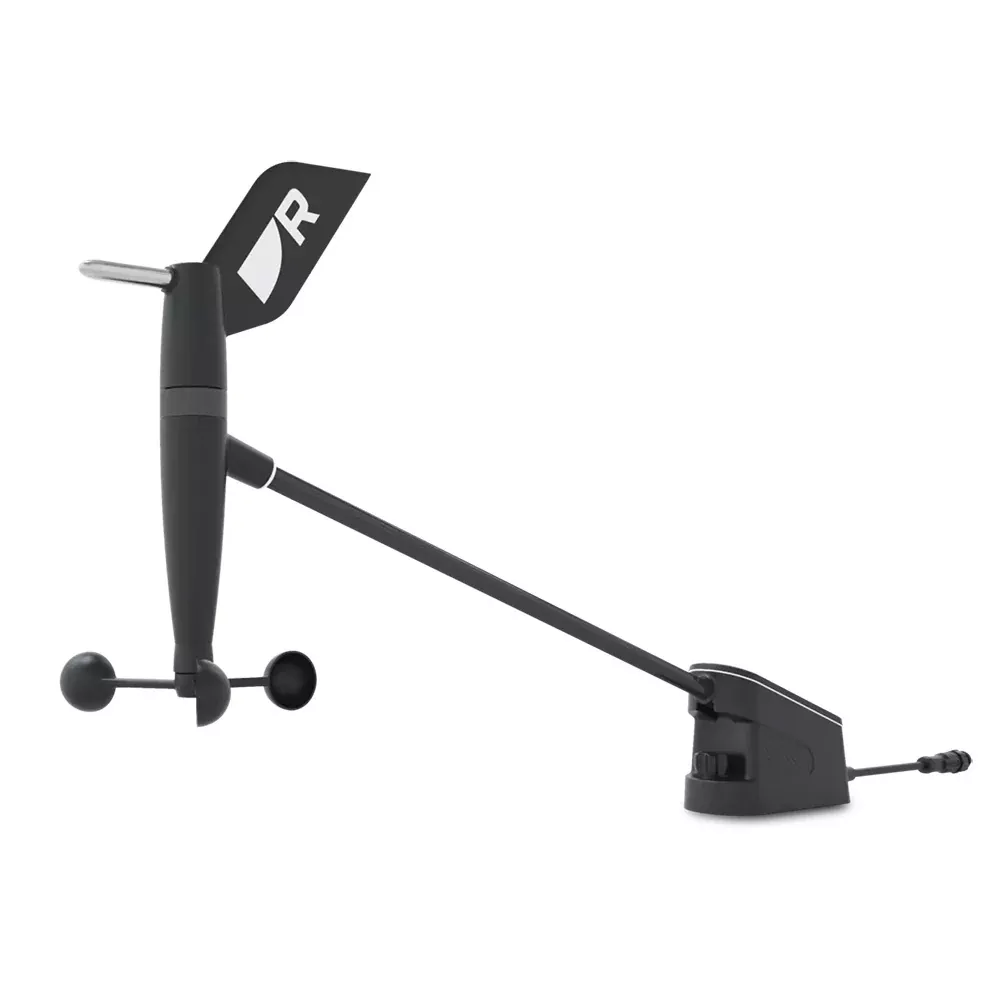
The Raymarine RSW Wired Smart Performance Wind Transducer (MPN E70670, UPC 723193846629) is a professional-grade masthead wind sensor for sailboats – calibrated true and apparent wind speed and direction data delivered directly to your Raymarine Alpha Performance Displays, Axiom chartplotters, i70 / i70s instruments, or any SeaTalk NG / NMEA 2000 network display. Short-arm variant with 30 meter (98.43 ft) Smart Wind mast cable included as standard – the right configuration for monohull sailboats up to 45-50 feet where the short arm gives better turbulence performance behind antennas / wind generators at the masthead, and the 30m cable run handles typical mast heights. Smart Wind technology delivers expert-level accuracy without requiring additional Raymarine processors or extensive on-water calibration – factory-calibrated through rigorous wind-tunnel testing for accurate data straight out of the box. Install and Go – just mount the transducer, run the cable down the mast, and connect to the SeaTalk NG backbone via the included Smart Wind wired gateway. Trusted, high-accuracy True Wind data lets you sail smarter: optimize sail trim, plot smarter tactical courses, validate polar performance during racing, and make better decisions about reefing and sail changes. 12V DC operation via SeaTalk NG (under 100 mW power consumption – negligible network load). Compatible with Raymarine SeaTalk NG instruments and chartplotters, plus standard NMEA 2000 networks via the included DeviceNet adapter cable. Wind speed range up to 115 mph (185 km/h). Masthead transducer rated IPx6/IPx7 for direct salt spray and rain exposure. EN 60945:2002 vibration tested. Includes everything for a clean install: transducer, gateway, 30m cable, mounting screws, heat shrink, ring crimp terminal, SeaTalk NG to DeviceNet adapter cable, and documentation.
The Raymarine RSW Wired Smart Performance Wind Transducer is Raymarine’s professional-grade masthead wind sensor for serious sailboat owners – cruising sailors who want accurate true-wind data for navigation and weather routing, plus performance sailors and racers who need calibrated wind data for sail trim optimization and tactical decision-making. The short-arm variant with the 30 meter cable is the right configuration for monohull sailboats up to 45-50 feet with typical masthead layouts.
Smart Wind technology – what it means in practice. Traditional masthead wind sensors output raw wind speed pulses and wind direction analog signals that require a separate calibration processor (like Raymarine’s older iTC-5 instrument transducer converter) to convert into usable wind data for the display network. Calibration was a multi-step process requiring sailing the boat in known conditions to dial in coefficients. Smart Wind eliminates the separate processor and the manual calibration – the transducer includes built-in signal processing that delivers calibrated true and apparent wind directly onto the SeaTalk NG / NMEA 2000 network. Plug it in, connect to the network, and you have accurate wind data immediately. The factory wind-tunnel calibration handles the precision work that owners previously had to do themselves on-water.
Short arm vs long arm – which is right for your boat. Raymarine offers the RSW Wired in both short arm (this variant) and long arm configurations. The arm length refers to the horizontal distance the wind cups extend forward of the masthead bracket – longer arm puts the cups further from the masthead’s turbulent airflow, but adds more use / vibration risk and more visual mass at the masthead. Short arm is the right choice for: smaller boats (under 45-50 ft) where the masthead layout is simple and turbulence is less of an issue, boats with VHF antennas / wind generators that fight for masthead space (short arm clears better), and owners who prefer lower visual mass at the masthead. Long arm is the right choice for: larger boats (45+ ft) where masthead turbulence from VHF antennas and other equipment is significant, and racing applications where the additional separation from turbulent airflow matters for the absolute most accurate wind data.
30 meter cable – what it covers. The included 30 meter (98.43 ft) Smart Wind mast cable handles typical mast heights on monohull sailboats up to about 45-50 feet. The cable runs from the masthead transducer down the inside of the mast (or via external conduit on shorter masts) to the Smart Wind wired gateway at the mast base or in the cabin. From the gateway, a short adapter cable connects to the SeaTalk NG backbone. For larger monohulls (50+ ft) or catamarans where the cable run from masthead to gateway exceeds 30 meters, you may need extension cables or a junction box – check the cable run length before purchase. For most boats, the 30 meter cable is enough with several meters of slack.
Wind tunnel calibration. Each RSW Wired transducer is factory-calibrated through rigorous wind tunnel testing – Raymarine validates the wind speed accuracy across the full operating range and the wind direction accuracy at all 360 degrees. The factory calibration is meaningful because masthead wind sensors are sensitive to small mechanical variations in the cup design, vane balance, and bearing friction – small differences between units can produce noticeable accuracy differences without proper calibration. The wind-tunnel-tested calibration delivers consistent unit-to-unit accuracy that you can rely on without further on-water tuning.
SeaTalk NG integration. The transducer connects to Raymarine’s SeaTalk NG network via the included Smart Wind wired gateway and SeaTalk NG to DeviceNet adapter cable. SeaTalk NG is Raymarine’s marine network protocol based on NMEA 2000 but with Raymarine-specific cabling and connectors. For boats with existing Raymarine instruments (i70 / i70s tactical displays, Axiom chartplotters, Alpha Performance Displays, p70 / p70s autopilot controls), the RSW Wired plugs directly into the existing SeaTalk NG backbone and starts delivering wind data immediately to all networked displays. For boats with standard NMEA 2000 networks (non-Raymarine), the same DeviceNet adapter cable allows direct connection – the transducer outputs standard NMEA 2000 wind PGNs that any NMEA 2000-compatible display can read.
What you can do with accurate wind data. True wind data (the actual wind in the world, calculated from apparent wind and boat speed) drives several useful sailing capabilities: (1) sail trim optimization – the wind data feeds your performance displays for real-time True Wind Speed (TWS), True Wind Angle (TWA), and True Wind Direction (TWD), letting you trim sails to the actual wind conditions, (2) polar performance validation – compare actual boat speed to predicted polar speed at each TWA, identifying when sails are not optimized, (3) tactical decision-making in racing – knowing the true wind across the racecourse drives strategic decisions on which side of the course will be favored, (4) navigation safety – true wind data combined with boat speed and direction lets the chartplotter calculate accurate waypoint ETAs accounting for wind effects, and (5) weather routing – the data integrates with weather routing software for optimal multi-day passage planning.
Power and network. The transducer draws power via the SeaTalk NG network – 12V DC, less than 100 milliwatts (effectively nothing – won’t meaningfully load your house batteries). NMEA 2000 LEN (Load Equivalency Number) is 1, also effectively nothing on the network load budget. The SeaTalk NG backbone needs to be protected by a 5A fuse per Raymarine’s network design standards. The transducer operates anywhere within the SeaTalk NG / NMEA 2000 voltage range of 9-16V DC.
Environmental ratings. Operating temperature range -25°C to +55°C (-13°F to +131°F) – covers any marine environment from arctic to tropical. Storage temperature range -30°C to +70°C (-22°F to +158°F). The masthead transducer is rated IPx6/IPx7 – protected against heavy seas and temporary submersion. The gateway (mounted below deck) is sealed against typical below-deck humidity. Maximum measurable wind speed is 115 mph (185 km/h) – well above anything you’d want to sail in. Vibration tested per EN 60945:2002, the IEC marine equipment standard.
What’s in the box. Complete install kit: masthead wind transducer, Smart Wind wired gateway, 30 meter mast cable on a reel for clean install, SeaTalk NG to DeviceNet adapter cable (4.72 in / 120 mm length), four No.10 x 3/4 inch self-tapping screws for transducer mounting, two No.7 x 3/4 inch self-tapping screws for gateway mounting, 40 mm heat shrink tube (for insulating ground wire if you shorten the mast cable), ring crimp terminal (for additional ground connection when gateway isn’t mounted on a metal surface), and documentation. Everything for a complete install except for any custom mounting hardware specific to your masthead bracket (if not using a standard Raymarine masthead bracket).
Install considerations. Plan for 4-8 hours for an experienced installer if you have mast access (hauled out or with the mast stepped). Key tasks: (1) mount the transducer to your masthead bracket using the supplied screws – critical that the bracket is level fore-aft (even 2 degree tilt skews apparent wind angle readings), (2) run the mast cable through the inside of the mast (or external conduit if internal routing isn’t available) – many installers fish the cable BEFORE stepping the mast since post-step installation requires mast removal or extensive rigging work, (3) connect the cable to the Smart Wind wired gateway at the mast base or in the cabin, (4) connect the gateway to your SeaTalk NG backbone via the included adapter cable with proper terminators at each end of the backbone, (5) power up the network and verify wind data on your instruments. Apply dielectric grease to the connector at the mast exit to prevent saltwater corrosion of the electrical connection over time – the connector exposure at the mast is a known long-term failure point on masthead instrumentation if not properly protected.