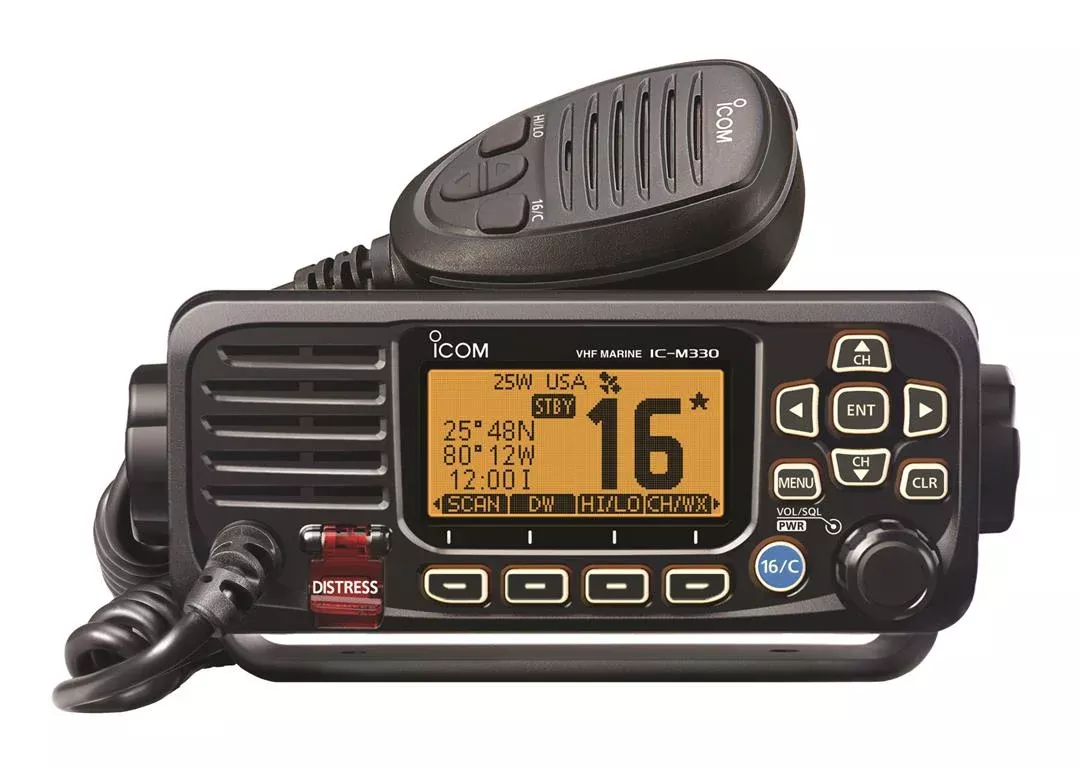
The Icom M330 Compact VHF Radio – Black (MPN M330 51, UPC 731797037664) is a 25-watt fixed-mount marine VHF radio engineered specifically to fit in tight installation spaces – delivers the same performance and feature set as Icom’s M324 series but in a smaller package designed for boats with limited dashboard space. Two key engineering choices distinguish the M330: compact form factor (substantially smaller than typical fixed-mount VHF radios, fitting installations where standard-size radios don’t fit) and value pricing (entry-level price point for the Icom marine VHF feature set). 25 watts of transmit power – the maximum legal for US fixed-mount marine VHF radios, delivers practical range of 10-20 NM ship-to-ship and 25-50 NM ship-to-shore for collision avoidance, weather monitoring, and routine marine communication. IPX7 waterproof rating – survives immersion in 1 meter of water for 30 minutes. AquaQuake draining function shakes water out of the speaker grille after submersion or heavy spray – critical for maintaining clear audio after wet exposure. Built-in Class D DSC (Digital Selective Calling) with a dedicated CH70 receiver – the modern marine emergency communication standard. The dedicated CH70 receiver monitors the DSC channel continuously while you operate on other channels, ensuring you don’t miss incoming DSC distress calls or position reports. Common NMEA 0183 interface for external GPS / chartplotter connection – lets the radio receive GPS position data for DSC distress calls (the radio transmits your exact position when you push the distress button). NOAA weather channels (10) with weather alert function. Tag scan and favorite channel functions for efficient channel monitoring. Receives US, Canadian, and International marine VHF channels. Full dot matrix display – clear and easy to read with all standard radio information. Directional keypad plus soft keys for simple smooth operation – most-used functions assigned to soft keys for quick one-push function access. Black color. The M330 is the right VHF for boats wanting Icom marine VHF quality and reliability at entry-level pricing with the compact form factor required for tight installations.
The Icom M330 Compact VHF Radio in Black is a 25-watt fixed-mount marine VHF radio engineered specifically to fit in tight installation spaces. It delivers the same performance and feature set as Icom’s M324 series but in a smaller package designed for boats with limited dashboard space.
Why the compact form factor matters. Standard fixed-mount marine VHF radios occupy substantial dashboard space – typically 6-8 inches wide, 3-4 inches tall, with several inches of depth for the electronics and connector access. For boats with limited dashboard real estate (small center consoles, bay boats with crowded helms, retrofit installations on older boats where the original dashboard was designed for smaller radios, sailboats with compact navigation stations), the standard radio size can be impossible to fit. The M330 reduces the form factor substantially while maintaining the same operational capability. Practical impact: VHF capability for boats that couldn’t accommodate a standard-size fixed-mount VHF, retrofit upgrades to older boats with smaller original radio cutouts, easier dashboard layout planning when other electronics need the space.
25 watts of transmit power. 25 watts is the maximum legal transmit power for US fixed-mount marine VHF radios. Practical range: approximately 10-20 nautical miles ship-to-ship in typical conditions (line of sight limited by Earth curvature and antenna height), 25-50 NM ship-to-shore station (because shore stations have higher antennas), and significantly more during atmospheric ducting conditions. For typical recreational and small commercial marine use, 25-watt fixed-mount range covers all practical communication scenarios – collision avoidance with other boats at substantial distance, contacting marinas / Coast Guard / commercial vessels, monitoring weather and emergency broadcasts. Switchable down to 1 watt for short-range communication in close quarters (marina hailing, close-range coordination) – reduces interference with distant stations and conserves battery on long radio sessions.
Class D DSC – the modern marine emergency standard. The M330 includes built-in Class D Digital Selective Calling – the modern marine emergency communication standard. The dedicated CH70 (DSC channel) receiver monitors the DSC channel continuously while you operate on other channels – you don’t miss incoming DSC distress calls or position reports from nearby vessels because you’re listening to channel 16 or working channels. Critical advantage over single-receiver DSC radios that can only monitor one channel at a time. DSC distress button (dedicated red button on the radio) transmits a digital distress signal including your MMSI number to all DSC-equipped vessels and coast stations in range. Receiving stations automatically display your distress call with audible alert. Compared to traditional voice distress calls (mayday on channel 16), DSC dramatically improves emergency response time and reliability.
GPS position with DSC. The M330 includes Common NMEA 0183 interface for external GPS / chartplotter connection. Connect the radio to your boat’s GPS or chartplotter via NMEA 0183 and the radio knows your current position. When you transmit a DSC distress call, the radio includes your exact GPS position in the digital transmission – rescue services know exactly where you are without needing to ask. Critical for emergency response time. Without an external GPS connection, the radio still transmits DSC distress with MMSI identification but without position – rescuers have to ask you to describe your location. NMEA 2000 isn’t supported on this compact radio – the older NMEA 0183 interface is used. For NMEA 2000 boats, an adapter / bridge may be required.
NOAA weather channels and alert. The M330 receives 10 NOAA continuous weather broadcasts on the dedicated VHF weather channels. The weather alert function automatically activates the radio when NOAA broadcasts severe weather warnings – useful for boats that need to monitor weather conditions without manually tuning the weather channel periodically. Critical for offshore boats or anywhere severe weather is a meaningful threat to safety.
AquaQuake draining function. AquaQuake is Icom’s exclusive water drain function that shakes water out of the speaker grille after submersion or heavy spray. Standard radios without this function develop muffled / distorted audio when water enters the speaker grille – the water blocks the speaker until it dries out (often taking hours). AquaQuake actively vibrates the speaker at audio frequencies to physically eject water from the grille within seconds. Practical impact: maintain clear audio after wet exposure without waiting for the radio to dry. Activate via a dedicated button on the radio.
IPX7 waterproof rating. The radio is rated IPX7 – survives immersion in 1 meter of water for 30 minutes. Practical translation: survives heavy rain, salt spray, wave wash over the dashboard, and brief accidental submersion without damage. Combined with AquaQuake, the radio handles wet conditions reliably. The IPX7 rating is sufficient for any practical marine installation including exposed dashboard positions on center consoles, walk-around helms, and sailboat cockpits.
Tag scan and favorite channel functions. The M330 includes advanced channel scanning: (1) Tag scan – scan only the channels you’ve tagged as relevant (vs scanning all available channels). Critical for efficient channel monitoring when most channels aren’t useful for your activity. (2) Favorite channel functions – quick access to your most-used channels via dedicated buttons. (3) Standard scan modes – scan all channels in sequence, priority scan (monitor channel 16 between scans of other channels), and others. The combination delivers efficient channel monitoring without manually switching between channels.
Full dot matrix display. The display is full dot matrix LCD – shows clear text and graphical information vs the legacy segment displays that only showed limited fixed information. Practical advantage: more information displayed at once, clearer channel and frequency display, easier menu navigation, readable in any light condition with backlight. Standard for modern marine VHF radios. the M330 delivers this in the compact form factor.
Channel coverage. Receives US, Canadian, and International marine VHF channels – the complete channel set used in all North American marine waters and most international cruising destinations. Includes the standard channel 16 (international distress / hailing), channel 9 (alternative hailing in some US waters), working channels for various marine activities, and weather channels.
What you don’t get. The M330’s value pricing involves some feature trade-offs vs higher-end Icom models: (1) No built-in GPS (use external NMEA 0183 GPS connection for DSC position). (2) No PA system (use a separate PA / hailer if needed). (3) No key lock (handle accidental button presses by careful placement and handling). For boats needing these features, look at higher-tier Icom models (M424G, M510, etc.) that add them at higher price points.
Install. Plan for 2-3 hours for an experienced installer. Tasks: cut the dashboard hole at the radio’s mounting footprint (smaller than standard VHF cutouts – measure carefully), mount the radio using the included bracket and hardware, route the antenna coax to a properly-installed VHF antenna (typically 8-foot fiberglass antenna – sold separately), wire 12V power through a 5A fuse, connect NMEA 0183 to chartplotter / GPS if applicable, configure your MMSI number per the included instructions (required before DSC features will work), test all functions before relying on the radio for actual communication.
Warranty. Icom standard limited warranty applies. Save the receipt and the original packaging. Warranty service runs through Icom America’s authorized service network. Most field failures Icom sees are install-related (poor antenna installation causing weak signal, wrong MMSI configuration causing DSC issues, undersized power wiring) rather than radio defects – careful install delivers many years of reliable service. Icom marine VHF radios have an excellent field reliability record across decades of production.