The Garmin OnBoard system replaces tethered kill cords with wireless tags. A captain tag that goes overboard cuts the engines, drops a MOB waypoint on your chartplotter, and sounds an alarm. It lets everyone move freely while the boat keeps watch, working with any boat that has an engine cutoff switch.
Tethered engine kill cords work, but they also tie you to the helm and get unclipped and forgotten. The Garmin OnBoard system fixes that with wireless tags instead of a physical cord. Everyone aboard wears a small tag, and the system integrates with your compatible Garmin chartplotter to watch over the boat while people move around freely. It’s a smarter, less annoying way to handle man-overboard protection and engine cutoff.
Here’s how it works. Each tag is designated as either captain or passenger through the chartplotter interface, and that designation changes what happens if the tag goes in the water. If a captain tag triggers a man-overboard event, the system does three things at once. It cuts power to the engines so the boat stops instead of driving away, it drops a MOB waypoint on your chartplotter at the spot where the tag lost connection, and it sounds an audible alarm on your displays and the hub. That combination gives a captain who goes over the best possible chance to get back to a stopped boat.
Passenger tags work a little differently, which makes sense. If a passenger tag goes overboard, the system marks a MOB waypoint and sounds the alarm, but it doesn’t cut the engines, so the captain stays in control to turn around and execute a recovery. You can manage all of this from the chartplotter, arming and disarming tags, switching a tag between captain and passenger, and checking each tag’s battery life, signal strength, and protection status at a glance.
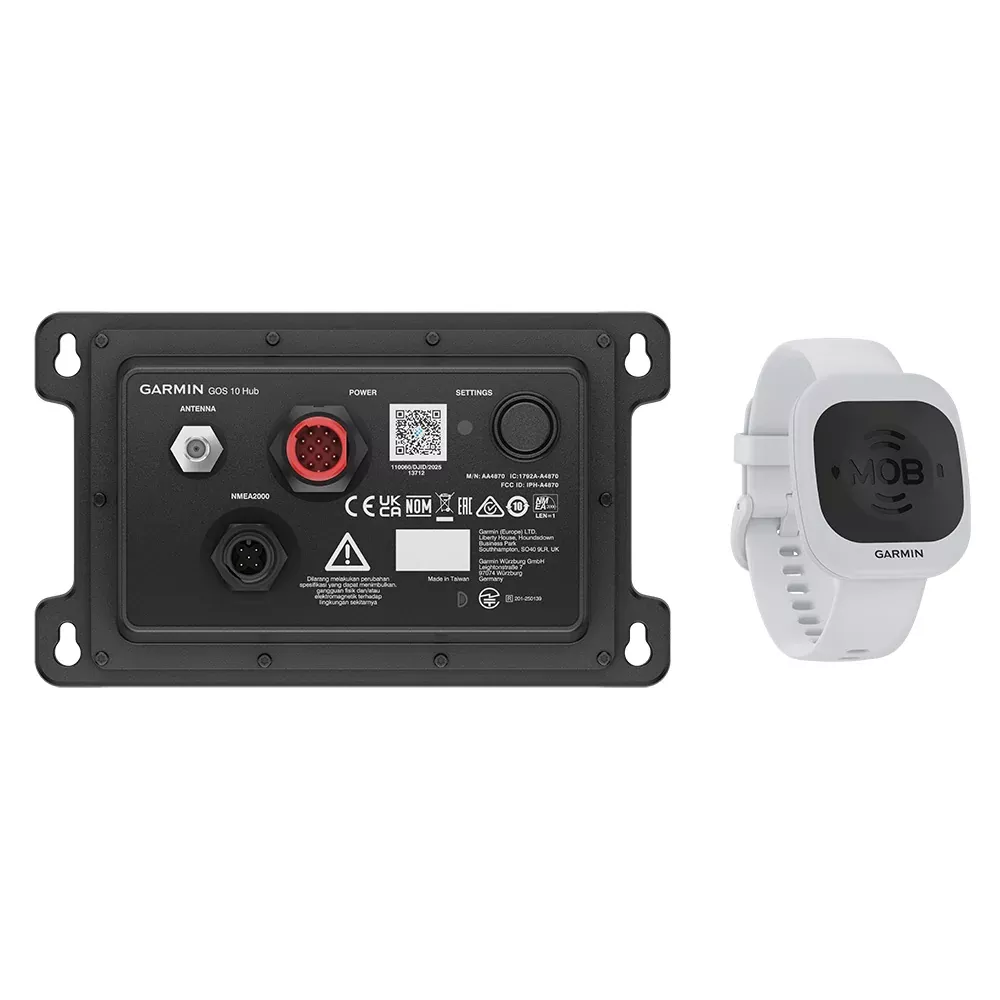
The tags themselves are built to be worn without fuss. They go on a wrist strap, clip to a carabiner, or ride on a floating foam keychain, so they fit however your crew moves around the boat. The tag is rated to IPX8, so it handles real submersion, and battery life exceeds 1,200 hours of connected time, comfortably more than a season of typical use, running on a common CR2032 coin cell. Wireless range is about 66 feet, and you can pair up to 8 tags at once, so a full boat of family or crew is covered.
At the center is the GOS 10 hub. It’s a compact unit, about 155 by 92 by 48 millimeters and 172 grams, rated IPX6 and IPX7 for the marine environment. It draws very little power, around 50 milliamps at 12 volts, and connects to your NMEA 2000 network with the included tee and drop cable. It includes a loud external alarm so a MOB event gets attention even away from the helm. Compass-safe distance is just 5 centimeters, so it’s easy to place.
Compatibility is broad. The system works with any boat that has an engine cutoff switch, and it interfaces with inboard, outboard, and sterndrive engines from all major manufacturers through a hardwired, in-line connection to the ignition harness. It supports up to 4 close-to-stop or 2 open-to-stop engines. In the box you get the GOS 10 hub, the 12-pin fused power and engine cutoff harness with external buzzer, the external antenna, the NMEA 2000 tee and 6-foot drop cable, one white MOB tag with band and carabiner, a floating keychain, a CR2032 battery, install hardware, and documentation.
A few practical notes for planning an install. Because the hub wires in-line to your ignition harness, it’s worth thinking through the job before you start, and many boaters have this professionally installed to be sure the engine cutoff is wired correctly. Once it’s in, the everyday use is simple. Hand out tags, designate the captain, and go. The system watches quietly in the background, and you interact with it mostly through the chartplotter when you want to check tag status or arm and disarm. That low-fuss operation is a big part of why a wireless system beats a cord you have to remember to clip on every single time.
Who’s this for? Any boater who wants modern, cordless man-overboard protection tied into a Garmin helm, especially families and crews where people move around and a single tethered cord isn’t practical. It’s peace of mind that doesn’t tie you to the wheel.