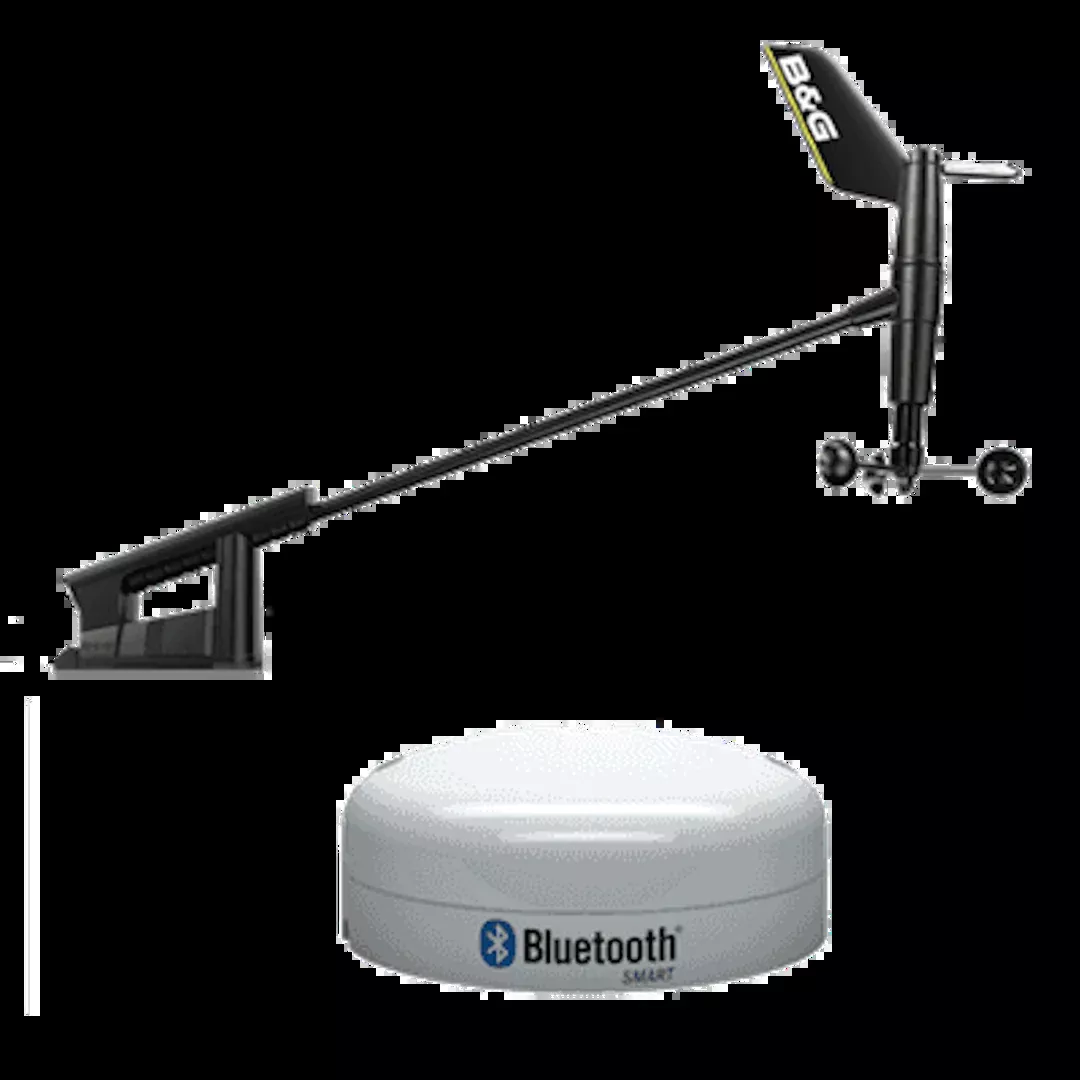
Imagine gliding through choppy waters with precise wind readings feeding straight into your chartplotter and autopilot—no tangled cables snaking up the mast, no downtime during installs. The B&G WS320 Wireless Wind Sensor Pack delivers exactly that, blending cutting-edge wireless tech with the reliability serious sailors demand. Tailored for cruising enthusiasts and club racers alike, this pack eliminates the hassle of traditional wired setups while matching—or exceeding—their performance.
Unlock Superior Wind Data Without the Wires
Sailors know wind is king on the water, dictating tactics from tacking angles to sail trim. The WS320 shines here, capturing apparent wind speed and angle at a blistering 5 Hz rate—five updates per second—for smoother, more responsive displays. Benchmarked in over 500 wind tunnel tests against rivals, it nails accuracy across all points of sail and heel angles, even in gusty conditions. Whether you’re pinching upwind in a 20-knot breeze or broad-reaching down a wave, expect wind speed precision within ±0.1 m/sec (0.2 knots) and angle accuracy of ±0.5°.
Installation Simplicity for Real-World Boating
Retrofitting wind sensors often means dropping the mast or drilling holes—pure frustration. Not with the WS320. Mount the lightweight sensor (just 0.32 kg) at the masthead using the included bracket, pair it wirelessly to the compact base station via Bluetooth (up to 30m range), and connect the base to your NMEA 2000 network with the drop cable and T-joiner. It’s ready in under an hour, ideal for masts up to 25 meters. Pro tip: Position the base station low on the mast or in the cockpit for optimal signal and easy access to monitor battery status through your B&G display.
Power That Lasts, Season After Season
Forget disposable batteries. The WS320’s smart rechargeable system, bolstered by solar charging, keeps it humming through long passages or multi-day regattas. Low-power design ensures data flows uninterrupted, even on cloudy overcasts. The base station sips just 1.2W from your 12V system, adding minimal load to your network (2 LEN). Built tough for marine extremes—IPX6/IPX7 waterproofing, -25°C to +65°C operation—it shrugs off spray, salt, and storms.
Engineered for Endurance: Tested Beyond Limits
As the yacht’s most vulnerable sensor, wind gear can’t afford weak links. B&G subjected the WS320 to over 200,000 hours of field testing, plus brutal lab simulations. Aerodynamic arms slice through air for minimal turbulence, delivering clean data to your autopilot for flawless auto-tacks and gybes. Racers appreciate the resolution (0.1° angle, 0.05 m/sec speed), while cruisers value the zero-maintenance vibe—no iced-up cups in subzero temps or UV-faded anemometers after years exposed.
What’s in Your WS320 Pack
WS320 Wireless Wind Sensor with solar-rechargeable battery
WS320 Wireless Interface Module (Bluetooth base station)
Masthead bracket and fixings kit (including pole mount)
NMEA 2000 drop cable (1.82m / 6 ft)
Micro-C T-joiner
Detailed Specifications at a Glance
Specification
Details
Sensor Weight
0.32 kg (0.7 lbs)
Waterproof Rating
IPX6 & IPX7
Operating Temperature (Sensor)
-25°C to +65°C
Power (Sensor)
Solar powered with rechargeable battery
Wind Speed Range
0.25–50 m/sec (0.5–97 knots)
Wind Angle Accuracy
±0.5°
Wireless Range
≤30 m (98 ft)
Base Station Dimensions
90 mm H x 38 mm (3.54″ x 1.50″)
Base Power Consumption
1.2 W (<100 mA at 12 V DC)
NMEA 2000 Load
2 LEN
Pro Tips for Maximizing Your WS320
Pair it with B&G’s Triton² or Zeus series for seamless integration—wind data overlays on charts, triggers laylines, and fine-tunes polar tables. Clean the arms seasonally with fresh water to banish salt buildup, and calibrate via your network for peak precision. For racing edges, log data to analyze puff patterns post-race.
Frequently Asked Questions
Is the B&G WS320 suitable for masts taller than 20 meters?
Yes, it’s optimized for masts up to 25 meters (80 feet), though performance can vary with installation specifics and local conditions like obstructions.